
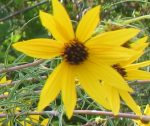
Willowleaf sunflower is a clump forming perennial native to south-central US, primarily in Missouri, Kansas, Oklahoma and Texas where it grows in limestone prairies and rocky outcrops. It is a member of the aster family, Asteraceae, that also includes daisy, yarrow, and lettuce. Growing from a rhizomatous root system the plants are 8-10′ tall and have pale green stems and long narrow drooping leaves 5-7″ long and resembling those of a willow. From late summer to late fall, panicles of 6-15 flowerheads appear that are 2-2.5″ wide and consist of 10-20 yellow ray flowers surrounding a center of 50 or more red to brown disc flowers. The flowerheads are attractive to butterflies, bees and birds, and are good in the vase. Willowleaf sunflower is a good choice for back of the border and meadow, prairie, cottage, wildlife, butterfly, and native plant gardens. The genus name, Helianthus, comes from the Greek words helios, meaning sun, and anthos meaning flower and may refer to the resemblance of the flowerhead to the sun. The specific epithet, salicifolius, comes from the Latin words salix the ancient name for willow, and folium, meaning leaf, and refers to the resemblance of the leaf to the leaf of the willow.
Type: Herbaceous perennial
Bloom: Flowerheads with yellow ray flowers surrounding dark red to brown disc flowers from late summer into fall
Size: 8-10′ H x 1-3′ W
Light: Full sun
Soil: Average, medium moist, well-drained, neutral to alkaline
Hardiness: Zones 4-9
Care: May need staking
Pests and Diseases: Rust, leaf spot, powdery mildew, aphids, caterpillars, beetles
Propagation: Seed, basal cutting in spring, division every 2-4 years
Companion Plants: Ornamental grass like Stipa calamagrostis, purple coneflower, smooth violet prairie aster
Outstanding Selections:
‘Autumn Gold’ (23-25″ tall)
‘First Light’ (3-4″ tall)
‘Low Down’ (10-12″ tall)
 Karen Meyers