
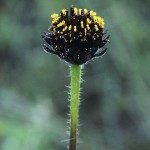
Also known as pineland sunflower, this tender perennial is native to southeastern US from South Carolina to Florida and eastern Louisiana where it grows in sandy uplands, along moist to dry roadsides, and in seasonally wet savannas and pine flatwoods. It is a member of the aster family, Asteraceae, that also includes daisy, yarrow and sunflower. Plants grow up to 40″ tall and have hairy stems with mostly basal leaves that are hairy, 2-6″ long, and egg-shaped to rounded. Stem leaves are shorter, linear, and hairy. A single flowerhead appears in late spring to early fall and has 100-150+ yellow to brown or purple disc florets typically with no ray florets. Sometimes 2-8 yellow ray florets may be present. The flowers are attractive to butterflies, bees and other pollinators and are a unique and interesting addition to wildlife, butterfly, native plant, and wildflower gardens. The genus name, Helianthus, comes from the Greek words helios, meaning sun, and anthos meaning flower and and may refer to the resemblance of the flowerhead to the sun. The specific epithet, radula, is the Latin word meaning scraper.
Type: Tender perennial
Bloom: Flowerhead with 100-150+ yellow to brown to purple disc florets usually lacking yellow ray florets, from spring to summer
Size: 3′ H x 1-3′ W
Light: Full sun
Soil: Average, seasonally moist to dry, well-drained, acidic
Hardiness: Zones 8-9
Care: Low maintenance
Pests and Diseases: Downy mildew
Propagation: Seed
Companion Plants: Tickseed, blanket flower, purple coneflower
Photo Credit: Florida Wildflower Foundation