
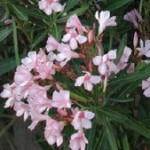
 Oleander is an evergreen shrub or small tree and a member of the dogbane family, Apocynaceae, that also includes blue star (Amsonia), periwinkle (Vinca), and milkweed (Ascelpius). Its native range is uncertain because it has been so widely cultivated over the centuries but it is generally associated with the Mediterranean Basin. Plants grow 6.5-20′ tall and have cane-like stems with shiny green twigs and carry pairs of whorls of 3-4, leathery lanceolate leaves 4-10″ long. The leaves are dark green above and paler with a prominent midrib below. From late spring to late summer, terminal clusters of 4-5 flowers appear. Each flower is 5-lobed, 2.5″ wide, and may be yellowish, red, white, pink, orange or purple. Some cultivars are fragrant and may have double flowers. Plants are very tolerant of drought, heat, air pollution, and salt so are a good choice for xeriscapes, urban gardens, highway plantings, and seaside gardens. All parts of the plant are poisonous but are very bitter so few animals eat enough of the plant to have a problem. The sap of the plant may cause skin irritation, dermatitis, and eye inflammation. The genus name, Nerium, comes from the Greek word neros, meaning water referring to the natural habitat of the plant along rivers and streams. The specific epithet is uncertain but a popular theory is that it is derived from Latin word olea, meaning olive tree, because of the resemblance of the leaf to those of the olive tree.
Type: Evergreen flowering shrub or small tree
Outstanding Feature: Flowers
Form: Rounded
Growth Rate: Rapid
Bloom: Clusters of 5 lobed pink, white, red, orange, yellowish and purple, from late spring to late summer
Size: 6.5-20′ H x 6-10′ W
Light: Full sun
Soil:Average, medium moist, well-drained but tolerates drought
Hardiness: Zones 8-10
Care: Prune in early spring to shape
Pests and Diseases: Generally healthy but susceptible to aphids, caterpillars, mealybugs, scale, armillaria, leaf spot, and sooty mold.
Propagation: Seed, softwood cuttings
Outstanding Selections:
‘Hardy Pink’ (tall, long blooming)
‘Mrs. Lucille Hutchings,’ (tall; white double flowers)
‘Algiers’ (dwarf; dark red)
‘Petite Salmon’ (dwarf)