
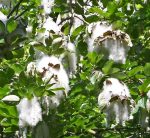
This deciduous tree is native to China, Japan, and Korea where it grows in sunny fluvial plains, river banks, and woodlands. It is a member of the willow family, Salicaceae, that also includes aspen and cottonwood. Growing up to 100′ tall, the trees have smooth yellowish bark when young, and gray deeply fissured bark when old. The heart-shaped leaves have conspicuous downy veins, bluntly toothed margins, and twisted tips. They are bright green above and white-felted beneath until fall when they turn yellow to orange. Pendent male and female catkins of inconspicuous flowers appear in late spring on different trees. The male catkins are 2-4″ long and have 30-40 stamens. The female catkins are up to 10″ long and give way in the fall to capsules with fluffy white appendages. Trees are valued for their tolerance of wet soil. Numerous hybrids are available. The genus name, Populus, is the classical Latin name for one member of the genus. The specific epithet, maximowiczii, honors the 19th century Baltic-German plantsman, Carl Johann Maximowicz, who was especially interested in Japanese flora.
Type: Deciduous tree
Outstanding Feature: Tolerance of wet soil
Form: Rounded or spreading
Growth Rate: Rapid
Bloom: Male and female catkins of inconspicuous flowers on different trees in late spring
Size: 100′ H x 30′ W
Light: Full sun to partial shade
Soil: Average, wet to dry, well-drained
Hardiness: Zones 4-7
Care: Low maintenance
Pests and Diseases: Anthracnose, bacterial canker, crown rot, aphids, beetle borers, mistletoe, scale, sooty mold
Propagation: Seed
Photo Credit:Wikipedia