
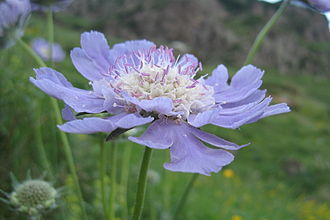
Native to Caucasus, north eastern Turkey, and northern Iran, thisherbaceous perennial is a member of the honeysuckle family, Caprifoliaceae, that also includes weigelia, Centranthus, and valerian. The plant grows up to 24″ tall and forms a clump of basal gray-green leaves that are lanceolate, covered with a whitish bloom, and may be pinnately-lobed. In summer, erect strong stems with narrow pinnately-lobed leaves carry single pale blue or lavender flower heads with frilly outer petals and a mass of central stamens that look like pins in a pincushion. The flowers are 2-3″ wide and very attractive to bees and other pollinating insects. The plants are most commonly grown for cut flowers but look good in informal settings such as cottage, butterfly and wildlife gardens. The genus name, Scabiosa, comes from the Latin word scabies meaning itch and refers to the leaves that were thought to cure scurvy. The specific epithet, caucasica, refers to the geographic area where the plant is native.
Type: Herbaceous perennial
Bloom: Pale blue or lavender flower heads with frilly outer petals and a mass of central stamens in summer
Size: 18-24″ H x 12-18″ W
Light: Full sun (partial shade in the South)
Soil: Moderately fertile, medium moist, well-drained, neutral to slightly alkaline
Hardiness: Zones 3-7 (does not tolerate high heat or humidity))
Care: Deadhead to prolong bloom; cut down foliage after blooming; divide every 3-4 years
Pests and Diseases: None of significance
Propagation: Division in spring, basal cuttings in sprig, seed
Companion Plants: Peach-leaved bell flower, Lady’s mantle, lamb’s ear
Outstanding Selections: Many cultivars are available but 3are especially outstanding.
‘Clive Greaves’ (lavender blue flowers)
‘Fama Deep Blue (4″ flowers)
‘Miss Wilmot’ (white flowers)
Photo Credit: Wikipedia