
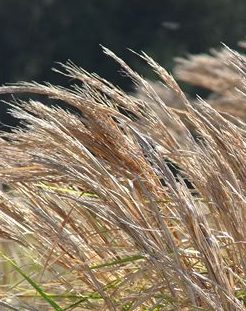
Also called beard grass and whiskey grass, broomsedge is a warm-season perennial grass native to southeastern US but has expanded its native range and can be found in abandon sites and waste areas of the Midwest, Northeast, California and Hawaii. In some areas it is considered an invasive weed. The common name, broomsedge, is misleading as the plant is not a sedge but a true grass and a member of the Poaceae family that also includes bamboo, rice, and corn. Plants form tufts of linear leaves that have short soft hairs and are 2-4′ tall. The stems are slightly flattened and branch toward the top. Both stems and leaves are green at first, but turn reddish brown to orange before fading to straw-color as they persist into winter. Finger like clusters of orange flowers with tufts of long white hairs appear in the fall through early winter and are attractive to butterflies and other pollinators. Broomsedge is an attractive architectural plant in the garden and is valued for informal sites such as prairie, meadown, wildlife, native plant, wildflower and butterfly gardens. It is also valued for erosion control and land reclamation but may inhibit the growth of other plants by producing persistent herbicidal hemicals as it decomposes. Early settlers made the dried stalks into brooms. The genus name, Andropogon, comes from the Greek words andros meaning man, and pogon meaning beard and refers to the hairy spiklets. The specific epithet, virginicus, refers to an area where the plant is native.
Type: Warm-season perennial grass
Bloom: Clusters of orange flowers with tufts of white hairs in fall to early winter
Size: 2-4′ H x 1-3′ W
Light: Full sun
Soil: Average, moderately moist, well-drained; tolerant of drought and lean soil
Hardiness: Zones 5-10
Care: Remove dead debris in late winter
Pests and Diseases: None of signficiance
Propagation: Seed, division
Companion Plants: Butterfly weed, purple coneflower, black-eyed Susan
Photo Credit: Wikipedia