
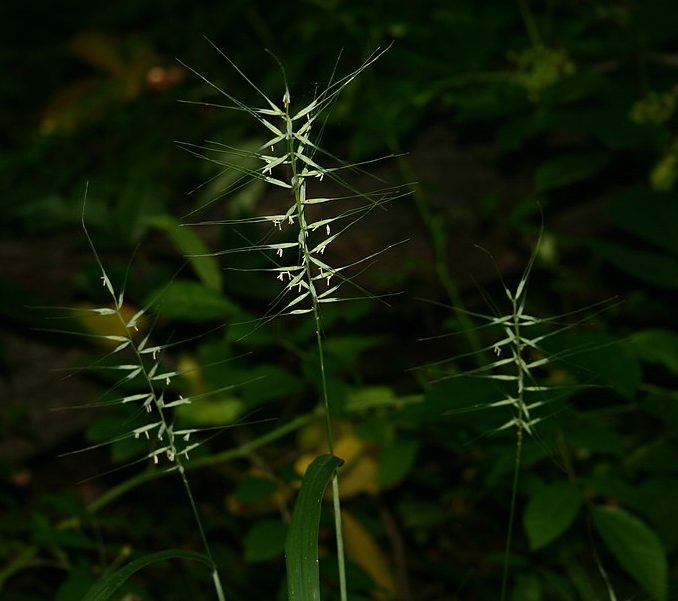
This cool season perennial grass is native to North America where it grows in woods and open clearings from Nova Scotia and Quebec to North Dakota and south to Virginia and Oklahoma. It is a member of the grass family, Poaceae, that also includes corn, rice, and bamboo. The plant forms tufts of linear, dark olive-green leaves that are 1/4-1/2′ wide and 4-8″ long. In mid summer, spikes of greenish, bristly, bottlebush-like flowerheads appear 1-2′ above the foliage. The flowerheads turn brown with maturity and shatter by early fall. Bottlebrush grass tolerates light shade and dry soil so is a good choice for woodland gardens and other partly shady settings. The flowers are attractive in fresh arrangements but must be cut as soon as they are fully open to avoid shattering. The genus name, Elymus, is from the ancient Greek word ἔλυμος (élumos) referring to millet. The specific epithet, hystrix, is from the ancient Greek word ὕστριξ (hústrix,) meaning porcupine, referring to the bristly appearance of the flowrheads.
Type: Cool season perennial grass
Bloom: Spikes of greenish, bristly, bottlebrush-like flowerheads in mid summer
Size: 3-4′ H x 1-2′ W
Light: Partial sun to light shade
Soil: Fertile, medium moist, well-drained; drought tolerant
Hardiness: Zones 4-9
Care: Cut back in late winter before new growth begins
Pests and Diseases: Aphids, leaf spot
Propagation: Seed, division in fall or spring
Companion Plants: Ear-leaved brome, hostas, Allegheny spurge
Photo Credit: JB Johnny Wikipedia