
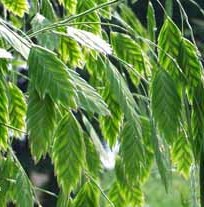
A native of the moist wooded areas of central and eastern US and northern Mexico, this deciduous, cool season, perennial grass is also known as woodoats, inland sea oats, and river oats. It is a member of the grass family, Poaceae, that also includes corn, rice, and bamboo. Plants form clumps of light green ribbon-like leaves about 2-5′ tall. In early summer flattened flowerheads up to 1.5″ long appear hanging from arching stems. They are green at first but change to gold and then brown tinged with purple as they mature. The seeds provide food for birds and small mammals and the foliage serves as a host for butterfly larvae. The flowering stems are beautiful in fresh or dried arrangements. Norther sea oats adds texture and movement to the garden and is a good choice for borders as well as native plant, wildflower, wildlife, water, rain and cutting gardens. It self seeds and spreads by rhizomes so can become weedy. The genus name, Chasmanthium, comes from the Greek words chasma, meaning yawn, and anthos, meaning flower. The specific epithet, latifolium, comes from the Latin words latus, meaning wide, and folia, meaning leaf.
Type: Cool season deciduous, perennial grass
Bloom: Flattened flowerheads hanging from arching stems from summer into fall
Size: 2-5′ H x 1-2′ W
Light: Full sun to part shade
Soil: Fertile to average, moist to wet
Hardiness: Zones 3-8
Care: Cut back before new growth appears in the spring
Pests and Diseases: None of significance
Propagation: Seed, division
Companion Plants: Ferns, hosta, sedges
Photo Credit: KVM