
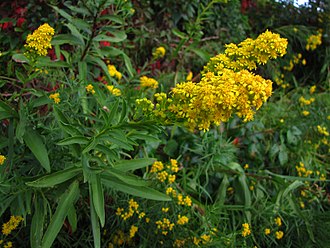
Also known as salt-marsh goldenrod, this succulent herbaceous perennial is native to coastal areas of eastern North America, parts of the Caribbean, Mexico, and Central America where it grows on sand dunes, salt marshes, banks of estuaries, and pinelands. It is a member of the aster family, Asteraceae, that also includes daisy, yarrow, and lettuce. Plants grow 2-8′ tall from a basal clump of narrowly ovate to oblanceolate sessile leaves up to 22″ long and 1.5 to 2.5″ wide. Stem leaves are 2-8″ long. From late summer into fall, large terminal or upper axillary panicles appear bearing dense, one-sided clusters of bright yellow flower heads on branches that often bend backward towards the base. The plants serve as a larval food source for wavy-lined emerald moth (Synchlora aerata), the flowers are a good nectar source for bees and butterflies, and the seeds are eaten by birds. Seaside goldenrod does not become invasive and is highly tolerant of salt spray. It is a good choice for seaside, wildlife, butterfly, and native plant gardens. The genus name, Solidago, comes from the Latin words solidus , meaning whole and ago meaning do, and refers to the wound healing properties of some members of the genus. The specific epithet, sempervirens, comes from the Latin words semper meaning always, and virere, meaning to be green, and refers to the foliage.
Type: Succulent herbaceous perennial
Bloom: Panicles of dense, one-sided clusters of bright yellow flowers from late summer into fall
Size: 2-8′ H x 2-3′ W
Light: Full sun
Soil: Sandy, dry to moist, well drained; tolerant of standing water, drought, and saline conditions
Hardiness: Zones 3-10
Care: Pinch in early summer to encourage bushiness
Pests and Diseases: Generally healthy but susceptible to damage by rust, powdery mildew, and leaf spot
Propagation: Seed, division
Companion Plants: American beach grass (Ammophila breveligulata), partridge pea (Chamaecrista fasciculata), beach pea (Lathyrus japonicus), trailing wild bean (Strophostyles
helvola).
Selections:
var. mexicana ( from Massachusetts south to Central America and the West Indies)
var. sempervirens (from Newfoundland south to Virginia; introduced in Great Lakes region)
Photo Credit: Wikipedia