
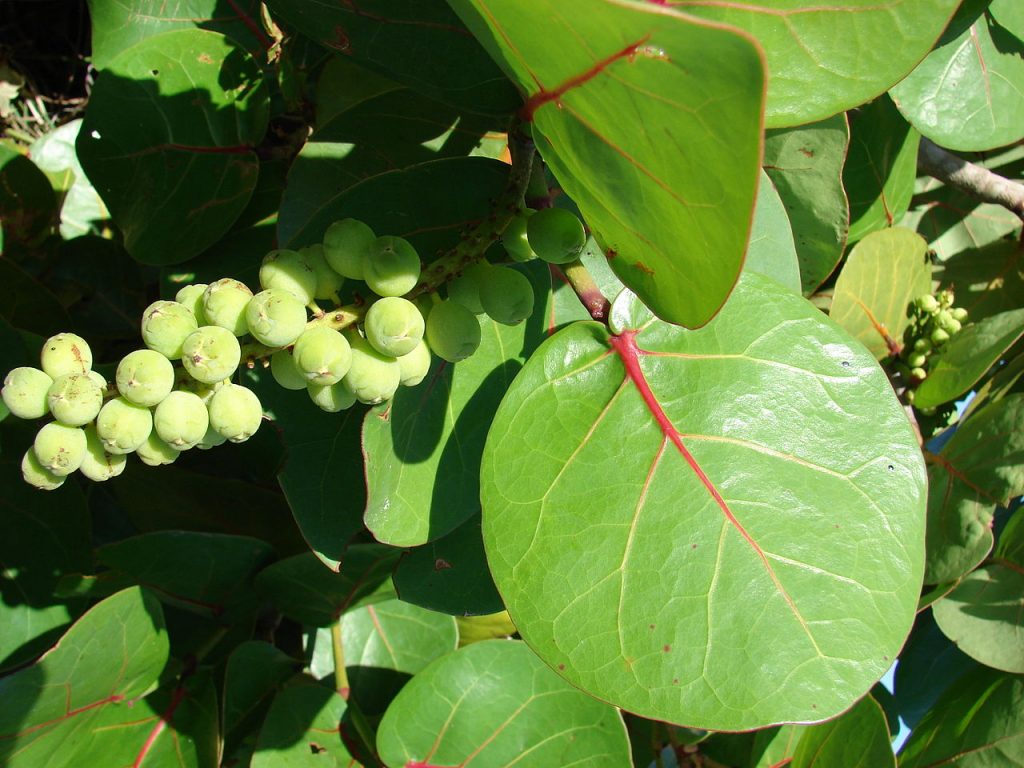
Also known as baygrape, this evergreen shrub or tree is native to tropical coastal beaches of America including southern Florida where it grows in coastal strands and limestone thickets. It is a member of the buckwheat family, Polygonaceae, that also includes rhubarb and dock. The plant grows 35-50′ tall and has multiple stems with smooth, mottled whitish, gray, and brown bark, and thin-peeling plates. The leathery, paddle-shaped leaves are 8-12″ long and have red veins. They are bronze when young, dark green with maturity, and may turn red in the fall. All through the year with a peak from spring to early summer, 12″ long racemes of inconspicuous male and female cream-colored flowers appear on different plants. Female flowers give rise to 3/4″ wide fleshy, grape-like fruits that ripen to deep purple in late summer and are eaten by birds and squirrels. In addition, the fruits may be eaten raw or cooked and is often made into jam. Sea grape is tolerant of wind, salt spray, drought when established, lean soil, occasional inundations and pruning. It is valued as a specimen tree, hedge, windbreak, habitat for small animals, and is a good choice for dune stabilization as well as native plant, coastal and wildlife gardens. The genus name, Coccoloba, comes from Greek kokkolobis, a kind of grape, literally, berry pod. The specific epithet, uvifera, comes from the Latin words, uva, meaning grape, and ferre, meaning to bear or carry.
Type: Evergreen shrub or tree
Outstanding Feature: Foliage, red coloration in fall, hurricane resistance
Form: Vase-shape
Growth Rate: Moderate
Bloom: Racemes of inconspicuous cream-colored male and female flowers throughout the year with a peak in spring to early summer
Size: 35-50′ H x 20-30′ W
Light: Full sun; tolerates some shade
Soil: Fertile, moist, well-drained; tolerates drought when established, lean sandy soils, occasional inundations, and salt spray
Hardiness: Zones 9-11
Care: Prune while young to establish strong structure to avoid breakage
Pests and Diseases: Sea grape borer, nipple gall
Propagation: Layering, seed (planted immediately)
Outstanding Selections: A variegated cultivar is available.
Photo Credit: Forest & Kim Starr Wikimedia Commons
 Karen Meyers