
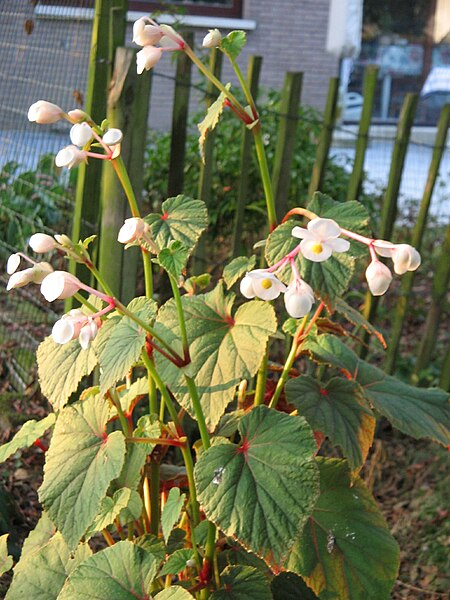
Blooming from mid-summer to through fall, this herbaceous perennial produces white or pink male and female flowers 1″ across in pendant clusters on the same plant. Branching stems carry heart-shaped leaves that are up to 4″ long, medium to olive green with red undersides, and form bushy mounds up to 2′ tall. Plants die back in winter but regrow in the spring from an underground tuber, and will form small colonies if allowed to self-sow. Fertilizer in early spring and deadheading to prolong flowering are all the care they need. Plants are generally healthy and the flowers have a slight fragrance so attract pollinators, especially bees. Good companion plants include hostas and ferns. Native to southern China, hardy begonia belongs to the Begoniaceae, a plant family of two genera and about 2040 species. The genus name, Begonia, honors Michael Begon (1638-1710), Governor of French Canada. The specific epithet, grandis, is the Latin word meaning big.
Type: Herbaceous perennial
Height: 2′
Light: Full shade to part shade
Soil: Average to fertile, medium moist, well-drained
Spread Speed: Moderate
Propagation: Seed; division
Hardiness: Zones 7-9
‘Heron’s Pirouette’ (green leaves, larger flowers in big clusters)
‘Claret Jug’ (smaller leaves with red undersides, pink flowers)
‘Pink Parasol’ (larger, pink flowers)
‘Wildwood Purity’ (leaves with dark backside, large white flowers)
Photo Credit: Meneerke bloem, Wikipedia