
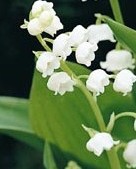
Lily of the valley is a rhizomatous herbaceous perennial native to the temperate parts of the Northern Hemisphere and grows best where summers are warm but not hot. Each plant has one to three basal leaves that are broadly lanceolate and about eight inches long. Five to fifteen nodding flowers are carried on one sided arching racemes in late spring. The bell-shaped flowers consist of five fused tepals, are usually white, sometimes pink, and are very fragrant. Orange-red berries with 1-6 seeds may follow in the fall. Lily of the valley can form extensive colonies in fertile moist, well-drained soil and part shade, and is useful under trees, even black walnut. It is deer resistant. Also called Mary’s tears and mayflower, lily of the valley is native to the Northern Hemisphere of Europe and Asia and is a member of the asparagus family, Asparagaceae, that also includes yucca, hosta and snake plant. The genus name, Convallaria, comes from the Latin prefix con- and the Latin word vallis meaning valley. The specific epithet, majalis, honors Maia, the Roman goddess of fertility associated with the month May when lily of the valley blooms. All parts of this plant are very poisonous.
Type: Herbaceous perennial
Height: 6-12
Light: Part to full shade
Soil: Fertile, consistently moist, well-drained; somewhat drought tolerant once established.
Spread Speed: Rapid in favorable conditions
Propagation: Root tips (pips)
Hardiness: Zones 2-5 optimum; 6-7 ok, struggles in 8.
Outstanding Selections:
‘Bordeaux’ (larger flowers above the foliage rather than in it; foliage on red stems.)
‘Lore Pleno’ (double flowers)
‘Rosea’ (pink flowers)
‘Albostriata’ (white striped leaves)
‘Berlin Giant'(taller than species)
Photo Credit: Wikipedia