
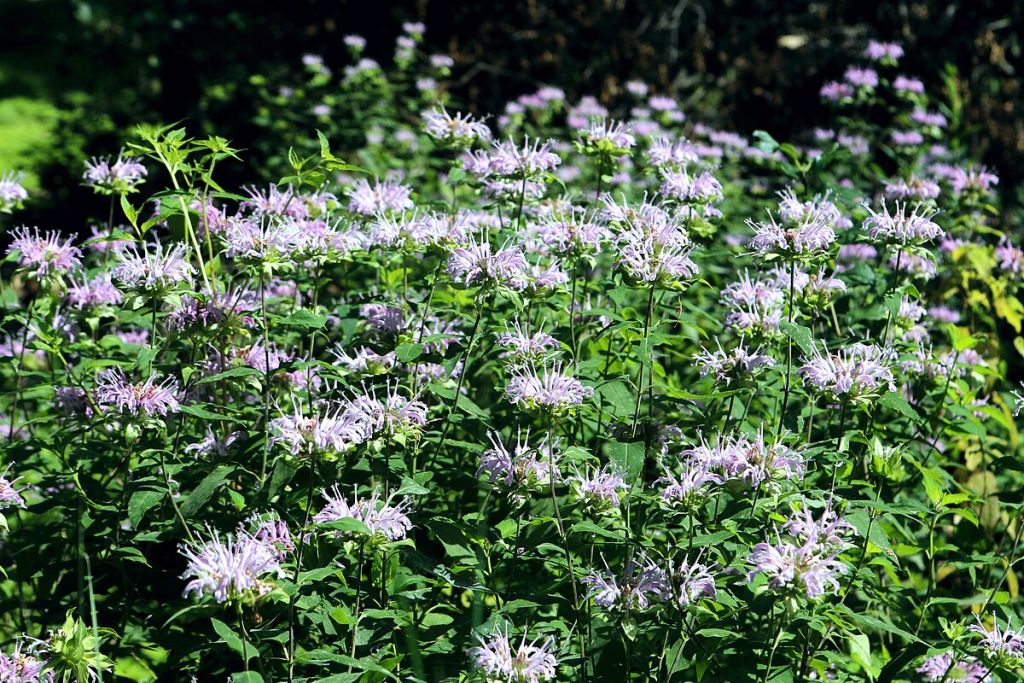
Also called bergamot, bee balm, horsemint, and oswego tea, Monarda is a genus of annuals and herbaceous perennials belonging to the deadnettle family, Lamiaceae, that also includes mint, lavender and sage. Plants grow 8-60″ tall and have stems that are square in cross section and carry lanceolate leaves 2.8-5.5″ long with toothed margins. The red, pink, pale yellow or light purple flowers are borne in terminal head-like clusters and are tubular with a narrow upper lip and a wider lower lip. The flowers attract hummingbirds and pollinating insects but the plants tend to develop powdery mildew in high humidity. They thrive moist, well-drained soil in sun but tolerate partial shade.
The genus name, Monarda, honors Nicholas Monardes (1493-1588), physician and botanist of Seville, Spain.
Photo Credit: Hardyplants, Wikimedia Commons
The environmental conditions on the Pacific Coast have resulted in at least four native species of Monarda there although they may be native to other places too. All of the Monardas described here are native to at least one of the states on the Pacific Coast.
Lemon Beebalm (Monarda citriodora)
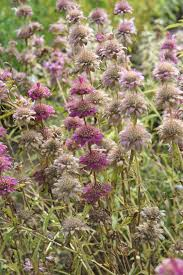
A stout stem bears aromatic, narrow, toothed green leaves up to 3″ long. From late spring to summer 2-6 interrupted clusters of lavender to pink or white flowers heads appear. The flowers are attractive to humming birds, butterflies and other pollinators, including bumble bees.
Alternate Name/s: Lemon mint, purple horsemint
Native Range: Californias well as parts of the Southwest, Rocky Mountain area, Midwest, and Southeast.
Habitat: Prairies, pastures, meadows, savannahs, open limestone areas, rocky slopes, hills
Type: Annual or biennial
Height: 1-2.5′
Bloom Time: Late spring through summer
Bloom Color: Lavender to pink or white
Light: Full sun to partial shade
Soil: Average, dry to medium moist, well-drained; alkaline
USDA Hardiness Zones: 2-11
Photo Credit: Michael Wolf, Wikimedia Commons
Scarlet Bee Balm (Monarda didyma)
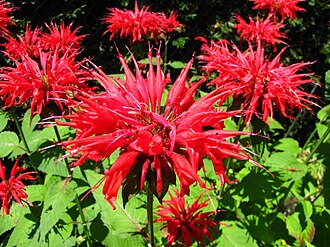
The coarse green leaves are 3-6″ long, ovate to lance shaped with serrated margins, and have reddish veins and hairy undersides. In early to late summer, bright red flowers appear in dense rounded terminal clusters of about 30 subtended by a whorl of red-tinged leafy bracts. The clusters are 3-4″ across and attract humming birds, butterflies, and other pollinators including bumble bees.
Alternate Name/s: Oswego tea, bergamot, crimson bee balm, Eau-de-Cologne plant
Native Range: Washington and Oregon as well as areas in the Midwest, Southeast, Mid Atlantic, and New England
Habitat: Moist woods, thickets, bottomlands and along stream banks
Type: Perennial
Height: 2-4′
Bloom Time: Summer
Bloom Color: Bright red
Light: Full sun; tolerates some shade
Soil: Fertile humusy, medium moist to wet, well-drained; does not tolerate drying out
USDA Hardiness Zones: 4-9
Photo Credit: NellsWiki, Wikimedia Commons
Wild Bergamot (Monarda fistulosa)
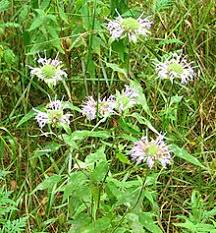
Oblong, grayish-green leaves are up to 4″ long. The pink to lavender flowers appear in dense, rounded terminal clusters subtended by a whorl of showy, pinkish, leafy bracts, and attract humming birds, butterflies, and other pollinators including bumble bees.
Alternate Name/s: Bee balm, eastern bergamot
Native Range: Washington and Oregon as well as all the rest of the US except Florida
Habitat: Prairies, fields, wet meadows, marshes, dry open woods, woodland margins
Type: Perennial
Height: 2-4′
Bloom Time: Summer
Bloom Color: Pink to lavender
Light :Full sun to partial shade
Soil: Fertile, dry to medium moist, well-drained; tolerates poor soil, drought and heat
USDA Hardiness Zones:3-9
Photo Credit: D. Garden E. Robertson, Wikimedia Commons
Spotted Beebalm (Monarda punctata)
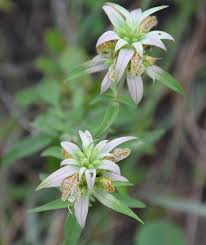
The narrowly lanceolate leaves are 1-3″ long and have dentate margins and a Greek oregano fragrance. Clusters of pale yellow flowers spotted with purple appear in in the leaf axils and stem ends over a long bloom time starting in late spring to summer. Each cluster is subtended by light pink to white tinged leafy bracts which are more showy than the flowers. The flowers attract hummingbirds, butterflies, and other pollinators including bumble bees and beneficial wasps.
Alternate Name/s: Dotted beebalm, dotted horsemint
Native Range: California as well as areas in the Rocky Mountain area, Southwest, Midwest, Southeast, Mid-Atlantic and New England
Habitat: Prairies, pastures, meadows, savannas, sandy areas, rocky woodlands, and coastal plains.
Type: Perennial
Height: 1-5′
Bloom Time: Late spring to fall
Bloom Color: Pale yellow spotted with purple
Light: Full sun, part shade
Soil: Average, sandy, dry to medium moist, well-drained; tolerant of drought and poor soil
USDA Hardiness Zones: 3-8
Photo Credit: Amber M. King, Wikimedia Commons
The three states of the Pacific coast, Washington, Oregon and California, have a great variety of geography and climate. The key factors uniting these states are the coastline along the Pacific Ocean and the presence of numerous mountain ranges. The area of the Pacific coast includes rainforests as well as semi-arid plateau and deserts. The climate varies with the geography with average annual rainfall ranging from over 130″ to less than 2″. Precipitation can be in the form of rain or snow. Likewise, summer temperatures can be over 110 F in Death Valley and down to -70 F in the mountains.