
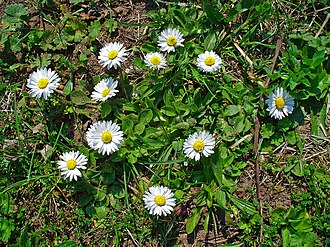
Also known as lawn daisy and English daisy, this herbaceous perennial is a member of the aster family, Asteraceae, that also includes chrysanthemum, dandelion, and lettuce. It is native to western, central and northern Europe where it grows in disturbed and cultivated areas like fields, meadows, and waste lots. Plants grow up to 8″ tall and form flat rosettes of small rounded or spoon-shaped leaves that are 3/4-2″ long. From early spring through summer, flowerheads appear singly on leafless stems. Each flowerhead is 3/4-1 1/4″ across and consists of white ray florets surrounding a center of yellow disc florets. The flowerheads exhibit heliotropism and follow the position of the sun in the sky. Plants can become weedy and are very difficult to remove from a lawn because of their flat growth habit. The genus name, Bellis, is the Latin word meaning pretty. The specific epithet, perennis, comes from the Latin words, per meaning throughout and annus meaning year, and refers to the life cycle of the plant.
Type: Herbaceous perennial
Bloom: Flowerheads of white ray florets surround a center of yellow disc florets from early spring through summer
Size: 6-8″ H x 4-8″ W
Light: Full sun to part shade
Soil: Organically rich, fertile, consistently moist, well-drained
Hardiness: Zones 4-8
Care: May burn out in hot weather; often grown as an annual or biennial
Pests and Diseases: None of significance
Propagation: Seed
Companion Plants: Muscari, violas, narcissus (spring bloom); pansies, kale, snapdragon (fall-winter bloom)
Outstanding Selection:
‘Pomponette’ (full pom-pom like flowerheads in shades of red, pink, or white
Photo Credit: Wikipedia
 Karen
Karen