
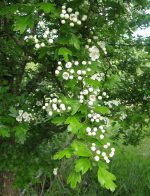
Common hawthorn is a thorny deciduous shrub or small tree and a member of the rose family, Rosaceae, that also includes cherry, lady’s mantle and almond. It is native to Europe, northwest Africa and western Asia but was introduced into the US and has become invasive in some areas. Also known as mayblossom, English hawthorn, whitethorn, one-seed hawthorn, and single-seeded hawthorn, plants grow 10-30’ tall, are densely branched, and have gray- brown bark with vertical orange fissures. The glossy green leaves are 1-1.5” long and have 3-7 deeply incised lobes. Clusters of 5-25 small white, five-petaled flowers have numerous red stamens and an unpleasant odor. They appear in late spring and give way to a one seeded red berry-like fruit that is attractive to birds and other wildlife that aid in seed dissemination. Prolific seed production and wide seed dissemination has led to the invasive nature of the plant. The genus name, Crataegus, comes from Greek word κράτος (krátos) meaning strength or hardness and refers to the hard wood of the plant. The specific epithet, monogyna, comes from the Greek words μόνος (monos) meaning single, and γυνή (gunḗ) meaning woman, referring to the presence of a single ovary in the flower.
Type: Deciduous shrub or small tree
Outstanding Features: Flowers, fruit
Form: Conical with rounded crown
Growth Rate: Moderate
Bloom: Cluster of 5-25 small, white, five petaled flowers with red stamens in late spring
Size: 10-30’ H x 10-30’ W
Light: Full sun to partial shade
Soil: Average, medium moist, well-drained, acid to alkaline
Hardiness: Zones 4-8
Care: Low maintenance
Pests and Diseases: Gall mites, aphids, leaf spot, fireblight
Propagation: Seed
Comments: Drought and pollution tolerant
Photo Credit: Lisa Jarvis, Wikipedia