
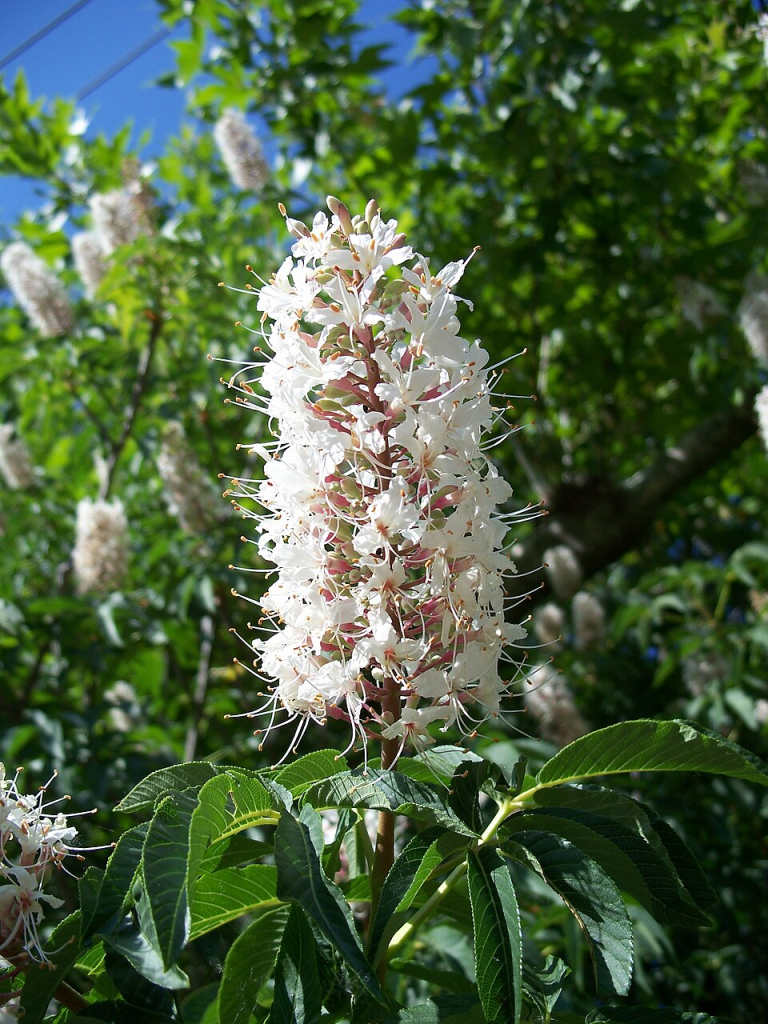
Species of buckeye native to North America and Eurasia are deciduous large shrubs or small trees. They are in the soapberry family, Sapindaceae , that also includes maple and lychee. Native species grow up to 79′ tall and have opposite, palmately compound leaves with 5-7 leaflets, occasionally 9. The leaflets have toothed margins and turn yellow to orange or bronze in the fall. Panicles of white, pink, red, or yellow, flowers appear from spring into early summer. The fruit that follows is a capsule containing 1-3 seeds. All parts of the plant are moderately toxic.
Buckeyes like full sun to partial shade and average, medium moist, well-drained soil in USDA Hardiness zones 6-9 but hardiness varies greatly among the species. Plants are generally healthy but may be damaged by leaf blotch, leaf scorch, powdery mildew and more. Propagation is by seed and cuttings.
The genus name, Aesculus, is the classical Latin name for a kind of oak tree.
Photo Credit: Wikimedia
The environmental conditions of the Pacific coast have resulted in at least one species of buckeye native to the Pacific Coast.
California buckeye (Aesculus californica)
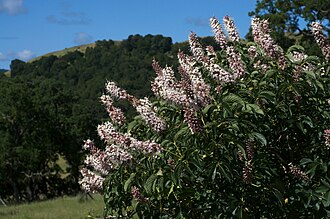
This deciduous large shrub or small tree has multiple stems and a open, broad crown. It has smooth, silver gray bark and 5 narrow-elliptic leaflets that are up to 6″ long and have fine toothed margins. Terminal panicles of fragrant, white to pinkish flowers appear in spring, The panicles are 4-12″ long and consist of 1/2″ wide, 5-petaled flowers with 5-7 exserted stamens. The fruit that follows is a light brown, pendent, pear-shaped capsule 2-3″ long, and usually contains a single seed that provides food for small mammals. Plants go dormant in summer.
Alternate Name/s: California horse chestnut
Native Range: Oregon and California
Habitat: Slopes, canyons and stream sides, in coastal and foothill areas
Type: Deciduous large shrub or small tree
Height: 13-39′
Bloom Time: Spring
Bloom Color: White to pinkish
Soil: Average, medium moist to dry, well-drained; tolerates a range of soil types.
Light: Full sun to partial shade.
USDA Hardiness Zones: 7-9
Photo Credit: Wikipedia
The three states of the Pacific coast, Washington, Oregon and California, have a great variety of geography and climate. The key factors uniting these states are the coastline along the Pacific Ocean and the presence of numerous mountain ranges. The area of the Pacific coast includes rainforests as well as semi-arid plateau and deserts. The climate varies with the geography with average annual rainfall ranging from over 130″ to less than 2″. Precipitation can be in the form of rain or snow. Likewise, summer temperatures can be over 110 F in Death Valley and down to -70 F in the mountains.