
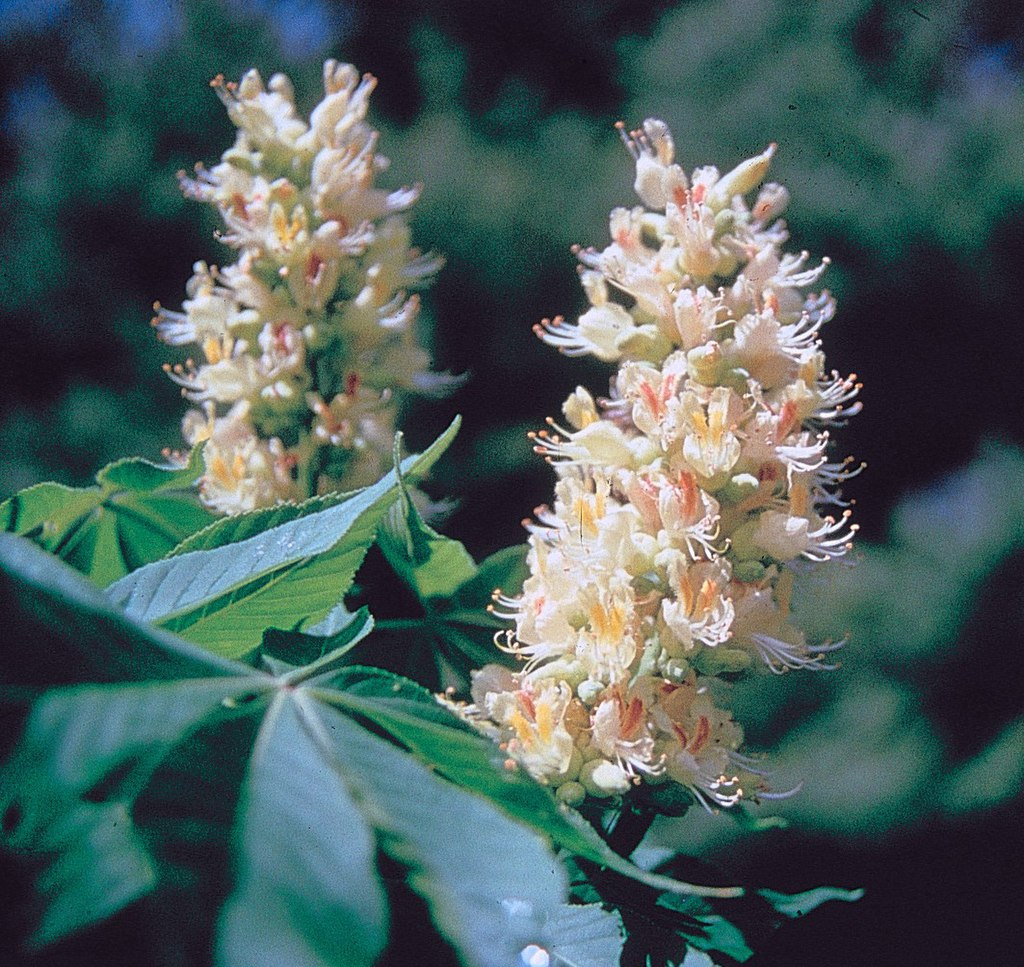
Native species of buckeye are usually deciduous large shrubs or small trees native to North America and Eurasia. They are in the soapberry family, Sapindaceae, that also includes maple and lychee. Native species grow up to 79′ tall and have opposite, palmately compound leaves with 5-7 leaflets, occasionally 9. The leaflets have toothed margins and turn yellow to orange or bronze in the fall. Panicles of white, pink, red, or yellow, flowers appear from spring into early summer. The fruit that follows is a capsule containing 1-3 seeds. All parts of the plant are moderately toxic.
Buckeyes like full sun to partial shade and average, medium moist, well-drained soil in USDA Hardiness zones 6-9 but hardiness varies greatly among the species. Plants are generally healthy but may be damaged by leaf blotch, leaf scorch, powdery mildew and more. Propagation is by seed and cuttings.
The genus name, Aesculus, is the classical Latin name for a kind of oak tree.
Photo Credit: Wikimedia
The environmental conditions of the Southeast have resulted in at least five species of buckeye native to the Southeast but they may be native to other areas of the US too. The buckeyes described here are native to at least three of the states in the Southeast.
Yellow Buckeye (Aesculus flava)
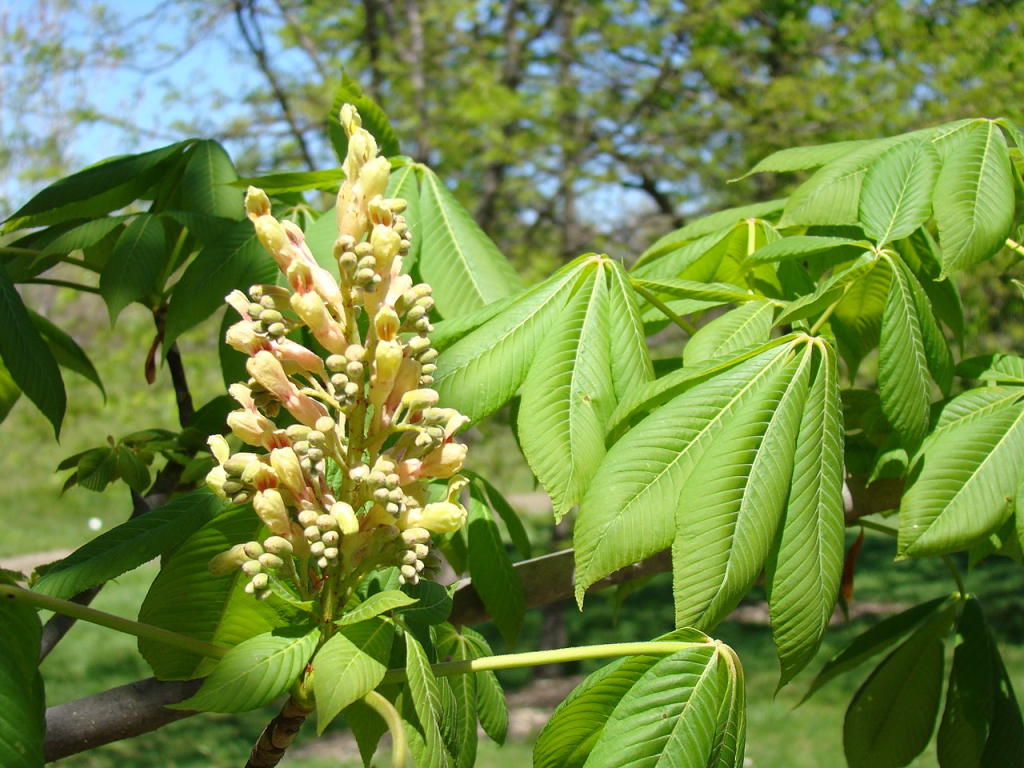
This large deciduous tree has an irregular upright-oval canopy, branches that usually sweep the ground, and bark that is sometimes exfoliating. The palmately compound leaves are 9-15″ long and usually have five oval, pointed leaflets that are 4-6″ long. The leaves turn yellow to orange or red in the fall. Panicles up to 7″ long carry cream to yellow to yellow-green flowers in spring. The flower are about 1″ long, and have 4 petals and stamens that are shorter than the petals. The fruit that follows is a round to oval, leathery, tan capsule 2-3″ in diameter and contains 1-2 seeds. The flowers attract hummingbirds, bees, butterflies, and other pollinators and the seeds are eaten by squirrels.
Alternate Name/s: Common buckeye, sweet buckeye, big buckeye
Native Range: Virginia, West Virginia, North Carolina, South Carolina, Georgia, Alabama, Kentucky and Tennessee as well as places in the Midwest and Mid-Atlantic
Habitat: Moderate to moist, rich soils on river bottoms, stream banks and mountain slopes
Type: Deciduous tree (sometimes a shrub)
Height: 50-75′
Bloom Time: Spring into summer
Bloom Color: Cream, to yellow, to red
Light: Full sun to partial shade
Soil: Average, medium moisture, well-drained
USDA Hardiness Zones: 4-8
Photo Credit: Wikimedia Commons
Ohio Buckeye (Aesculus glabra)
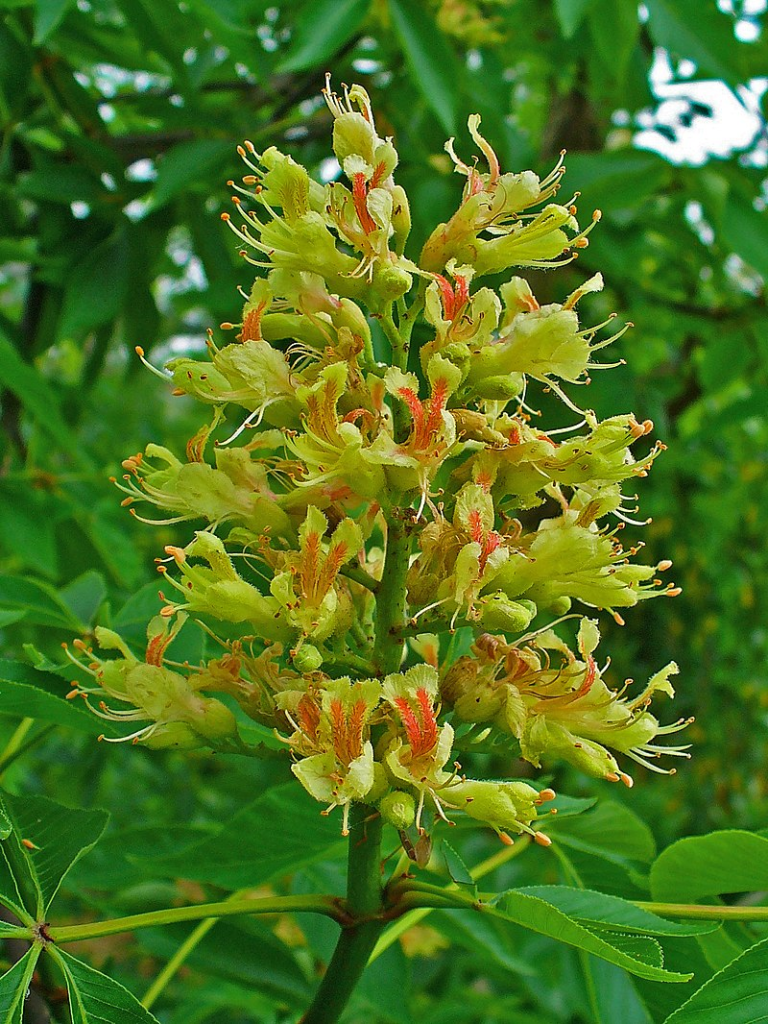
This small to medium sized deciduous tree is low-branched and has a broad oval-rounded crown. The palmately compound leaves have 5 elliptic to obovate leaflets, that are 3-6″ long. Fall foliage is usually yellow, but may become orange-red or reddish-brown. Terminal panicles of greenish yellow flowers appear in mid to late spring. The panicles are 4-7″ long, and the flowers are 1″ long, and 4-petaled with the stamens longer than the corolla. The fruit that follows is a small spherical capsule with a prickly or warty covering and contains one to three seeds. The flowers, bark, and stems, have an unpleasant odor when crushed.
Alternate Name/s: Horse chestnut, fetid buckeye, stinking buckeye
Native Range: Virginia, West Virginia, North Carolina, Georgia, Alabama, Mississippi, Arkansas, Kentucky, Tennessee as well as places in the Southwest, Midwest, Mid-Atlantic and New England
Habitat: Moist stream banks, bottomlands, woodlands, thickets
Type: Deciduous tree
Height: 20-40′ (to 75′ in the wild)
Bloom Time: Mid to late spring
Bloom Color: Greenish yellow
Light: Full sun to partial shade
Soil: Average, medium moist, well-drained, slightly acidic
USDA Hardiness Zones: 3-7
Photo Credit: Wikimedia Commons
Bottlebrush Buckeye (Aesculus parvifolia)
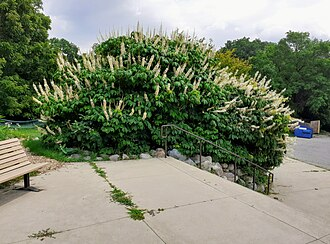
Considered one of the best flowering shrubs for shade, bottlebrush buckeye is deciduous, suckering, and multi-stemmed. The lowest branches are horizontal and the shrub forms an attractive mound. The palmately compound, green leaves have 5 to 7 leaflets 3-8″ long, and turn yellow to yellow-green in the fall. In summer, white flowers appear in panicles 6-12″ long. Each flower is 1/2″ across, and has stamens with red anthers and pinkish filaments that extend beyond the 4 petaled corolla. The flowers attract hummingbirds, butterflies, and other pollinators. The fruit that follows is a leathery, pear-shaped tan capsule 1-3″ long.
Alternate Name/s: Dwarf buckeye, dwarf horse chestnut
Native Range: South Carolina, Georgia, and Alabama as well as places in the Mid-Atlantic
Habitat: Moist woodlands
Type: Deciduous shrub
Height: 8-15′
Bloom Time: Summer
Bloom Color: White
Light: Part shade to full shade
Soil: Average, consistently moist, well-drained, acidic; intolerant of drought
USDA Hardiness Zones: 4-8
Photo Credit: Wikipedia
Red Buckeye (Aeculus pavia)
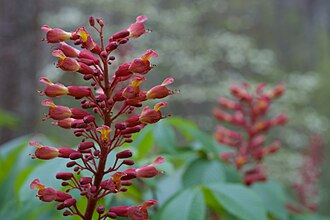
Red buckeye is a clump-forming deciduous shrub or small tree with an irregular rounded crown. Its palmately compound leaves usually have 5 elliptical leaflets that are 4-8″ long, have toothed margins, and turn an unremarkable red in the fall. In spring, 4-10″ long panicles of red to orange-red flowers (occasionally yellow) appear. The flowers are narrowly tubular, 1-1.5″ long, and may have exerted stamens. The fruit that follows is a 1-3″ long tan leathery capsule with 1-3 seeds. The flowers are attractive to hummingbirds, butterflies and other pollinators and the seeds are eaten by squirrels.
Alternate Name/s: Firecracker plant, scarlet buckeye, red horse chestnut
Native Range: Virginia, North Carolina, South Carolina, Georgia, Alabama, Mississippi, Louisiana, Arkansas, Kentucky, Tennessee, and Florida as well as places in the Southwest, Midwest, and Mid-Atlantic
Habitat: Wooded slopes and valleys, along streams, in thickets.
Type: Deciduous small tree or shrub
Height: 12-25′
Bloom Time: Spring
Bloom Color: Red to orange-red, occasionally yellow
Light: Partial shade to full sun
Soil: Average, medium moist, well-drained
USDA Hardiness Zones: 4-8
Photo Credit: Wikipedia
Painted Buckeye (Aesculus sylvatica)
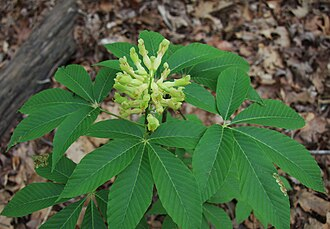
This dense, rounded deciduous shrub or small tree is usually multi-stemmed and has palmately compound leaves usually with 5 leaflets,4-6″ long, with finely toothed margins and yellow to orange midveins. The leaves may start out reddish. In spring, flowers appear in panicles 4-6″ long. Each flower is 1 to 1.25″ long, bell-shaped with 4 unequal petals and stamens shorter than the corolla. The petals may be yellow, yellow-green, cream, pink or red. The fruit that follows is a globe-shaped tan leathery capsule usually containing one seed. The flowers attract hummingbirds, butterflies and other pollinators and the seeds are eaten by squirrels.
Alternate Name/s: Dwarf buckeye, Georgia buckeye
Native Range: Virginia, North Carolina, South Carolina, Georgia, Alabama and Tennessee
Habitat: Forest, woodlands, bottomlands, ravines, slopes
Type: Deciduous shrub or small tree
Height: 6-20′
Bloom Time: Spring
Bloom Color: Cream, yellow, yellow-green, red or yellow with red veining
Light: Part shade to sun
Soil: Humusy, consistently moist, well-drained; intolerant of drought
USDA Hardiness Zones: 7-8
Photo Credit: Wikipedia
The Southeast includes Virginia, West Virginia, North Carolina, South Carolina, Georgia, Alabama, Mississippi, Louisiana, Arkansas, Kentucky, Tennessee, and Florida. Most of these states are characterized by hot, humid summers and cool to mild winters, with Florida’s tip being tropical. Summers are generally hot and humid throughout the entire region. Precipitation is abundant in the area and comes mostly in the form of rain.