
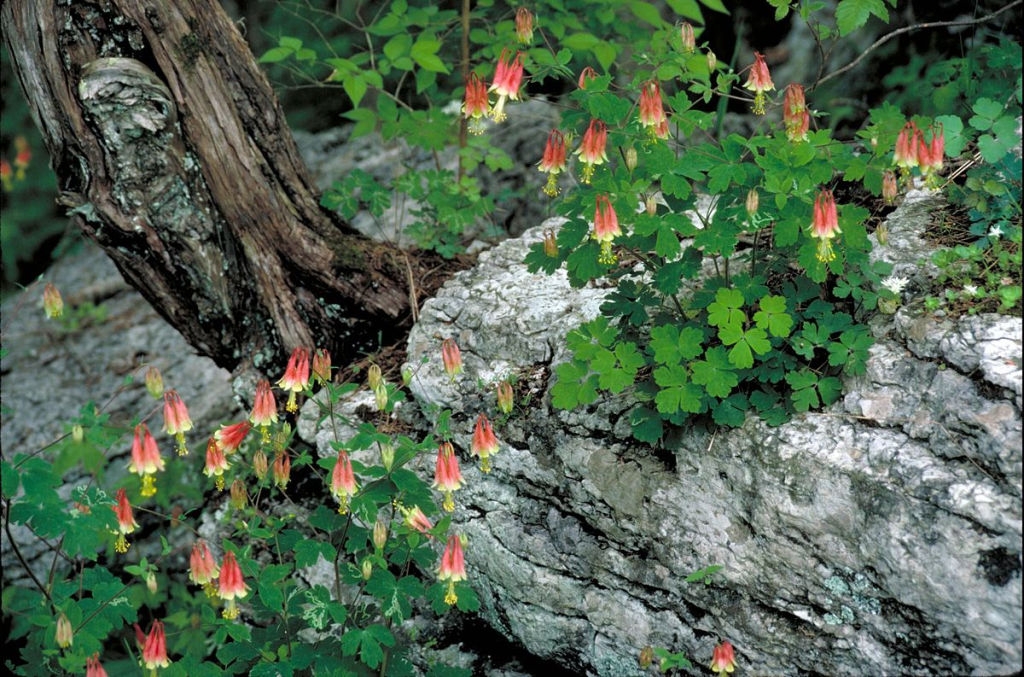
Aquilegia, also known as granny’s bonnet, is a genus of perennials native to the meadows and woodlands of the Northern Hemisphere. It is a member of the buttercup family, Ranunculaceae, that also includes anemone, hellebores, and bugbane. Growing 4″ to 5′ tall, plants form erect clumps of basal foliage and have slender, branching leafy stem. The ferny leaves are carried on long petioles, and are pinnately compound 1-3 times usually with 3-lobed leaflets. Flowers may be white, yellow, red, blue or combinations. They are erect or nodding, and usually have 5 petal-like sepals alternating with 5 true petals surrounding a center of numerous stamens. The petals have a broad tube in front and a projecting spur behind with spur length varying with the species. Columbines tend to thrive in part shade and in fertile, moist, well-drained soil, but tolerate less. They are generally short-lived and prone to disfigurement by leaf miners. Many attract pollinators.
The genus name, Aquilegia, comes from the Latin word aquila meaning eagle in reference to the resemblance of the spurs to the talons of an eagle.
Photo Credit: Dr. Thomas G. Barnes, U.S. Fish and Wildlife Service
The environmental conditions in the Mid-Atlantic have resulted in at least 1 native species of columbine there but it is native to other places too.
Eastern Red Columbine (Aquilegia canadensis)
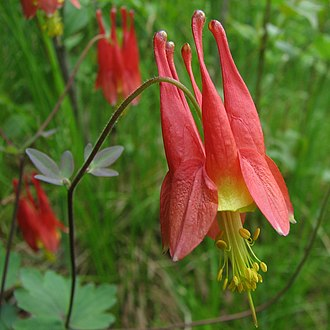
The compound leaves are divided into 3 leaflets. Each leaflet is oval, up to 3″ long, and has rounded lobes. The nodding flowers are 1-2″ across and have red spreading sepals and yellow petals with red spurs. The flowers are attractive to humming birds, butterflies, and other pollinators including bumble bees. The seeds attract birds.
Alternate Name/s: Wild Columbine, Jack in Trousers, Turks Cap
Native Range: All of the Mid-Atlantic as well as places in New England, the Southeast, Midwest, and Southwest.
Habitat: Woodlands with calcareous soils
Type: Perennial
Height: 2-3′
Bloom Time: Spring
Bloom Color: Red, yellow, pink
Light: Partial shade to full sun
Soil: Humusy, moderately moist, well-drained
USDA Hardiness Zones: 3-8
Photo Credit: Wikipedia
The Mid-Atlantic region includes Delaware, Maryland, New Jersey, New York, Pennsylvania, and the District of Columbia. The region is characterized by cold winters and hot summers, high humidity in summer along some areas along the coast, and precipitation between 32 and 52″ per year.