
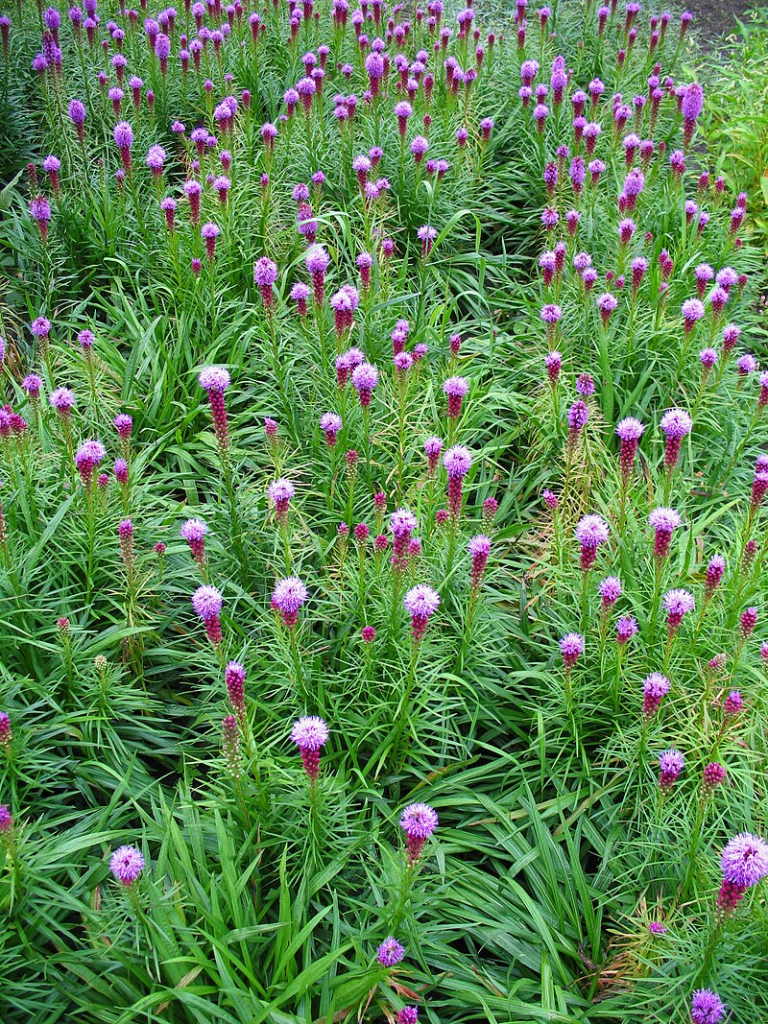
Often known as gayfeathers or blazing stars, these herbaceous perennials are a member of the aster family, Asteraceae, that also includes daisy, zinnia, and lettuce. They are native to North America where they grow in well-drained soil in full sun. The plants have strong straight stems that carry narrow leaves and terminate in a spike-like inflorescence of 15-45 purple flowerheads. The flowerheads are composed entirely of disc florets and open from the top to the bottom of the spike. Many species have flowers that are attractive to pollinators including butterflies, and are good in bouquets.
Photo Credit: Marc Ryckaert, Wikimedia Commons
The environmental conditions of New England have resulted in at least two native species of Liatris there but they may be native to other places too. The liatris described below are native to at least one of the states in New England.
Savanna Blazing Star (Liatris scariosa)
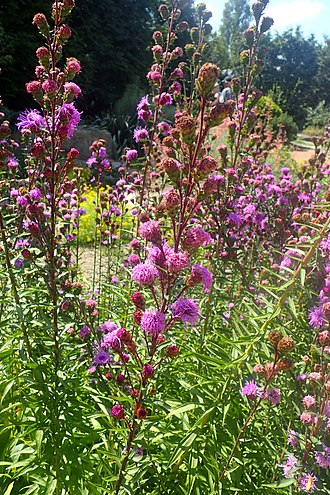
Also called devil’s bite, savanna blazing star is native to dry woods and clearings of Maine, New Hampshire, and Connecticut as well as parts of the Mid-Atlantic, Midwest, and the Southeast. It forms basal tufts of narrow leaves up to 10″ long and has stem leaves up to 3″ long. In late summer to early fall, flowering stems 2-4′ tall produce interrupted clusters of fluffy flower heads in terminal racemes up to 18″ long. The flower heads are reddish-purple, 1″ across and attractive to hummingbirds, butterflies, and other pollinators. The seeds are attractive to songbirds.
Height: 2-4′
Bloom Time: Late summer to early fall
Bloom Color: Reddish purple
Light: Full sun
Soil: Sandy to average, dry to medium moist, well-drained; tolerates poor soil, summer heat and humidity
USDA Hardiness Zones: 3-8
Photo Credit: Krzysztof Ziarnek, Wikimedia Commons
Blazing Star (Liatris spicata)
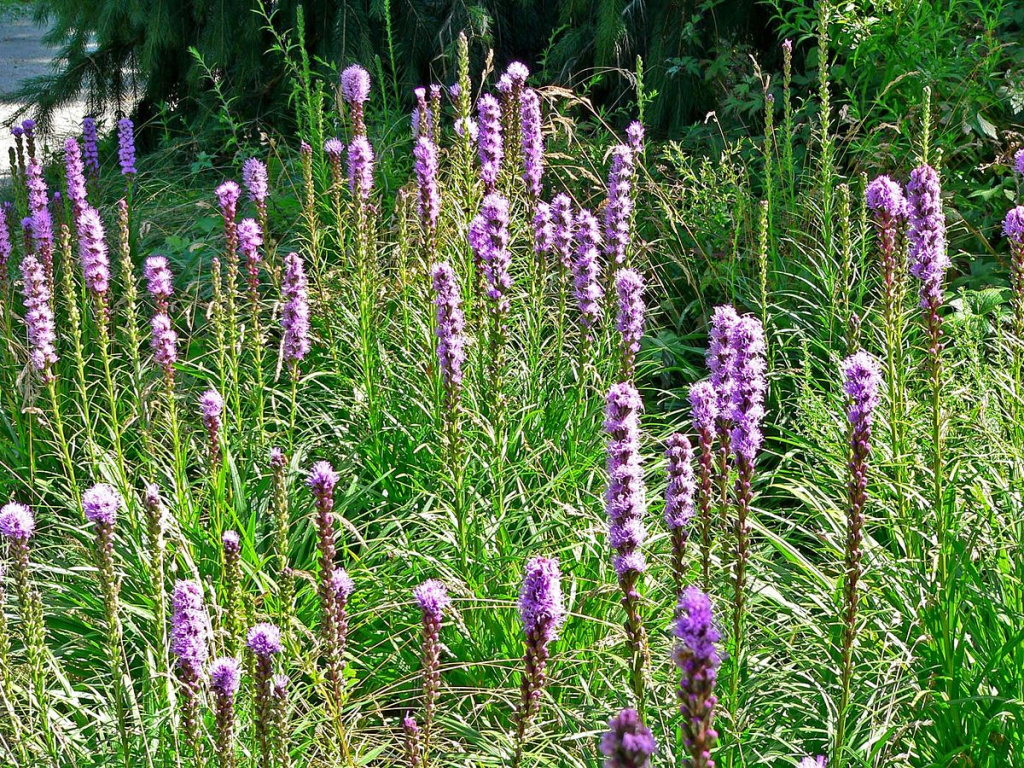
Known by many names including dense blazing star, dense button snakeroot, gayfeather, marsh blazing star ,sessile-headed blazing star, snakeroot, and spike gayfeather, this popular wildflower is native to Connecticut and Massachusetts as well as to parts of the Midwest, Southeast, and Mid-Atlantic. It grows in a variety of habitats including moist, wood openings, mesic prairies, meadows, and marsh edges. Plants form clumps of grass-like leaves up to 12″ long and leafy flower stalks up to 6′ tall. The red-purple flowerheads are densely arranged in terminal spikes 6-12″ long. They appear from mid summer to mid fall, are 3/4″ across, and are attractive to hummingbirds, butterflies, and other pollinators. The seeds are attractive to song birds.
Height: 2-6′
Bloom Time: Summer
Bloom Color: Red-purple
Light: Full sun
Soil: Average, medium moist, well-drained; tolerates summer heat and humidity
USDA Hardiness Zones: 3-8
Photo Credit: Stan Shebs, Wikimedia Commons
The New England area includes Maine, New Hampshire, Vermont, Massachusetts, Rhode Island and Connecticut. The area offers 4 distinct seasons and diverse geography with rivers, lakes, forests, mountains, and coast lines on both the Atlantic Ocean and Long Island Sound. The winters are long, cold, and heavy snow is common from December to February. Summer is short with temperatures between 80 and 85 F. Precipitation averages about 45″ as rain and 60-90″ as snow.