

The common name, poppy, can refer to many different plants some of which are considered true poppies, while others resemble poppies but are not even in the same plant family. This article only treats plants that are in the subfamily Papaveroideae of the family Papaveraceae; it does not include plants that are not botanically related to true poppies even if their flowers resemble poppy flowers or their common names are poppy. Photo Credit: Wikipedia
The environmental conditions in the Midwest have resulted in only one native species of poppy there but it is native to other places too.
Crested Prickly Poppy (Argemone polyanthemos)
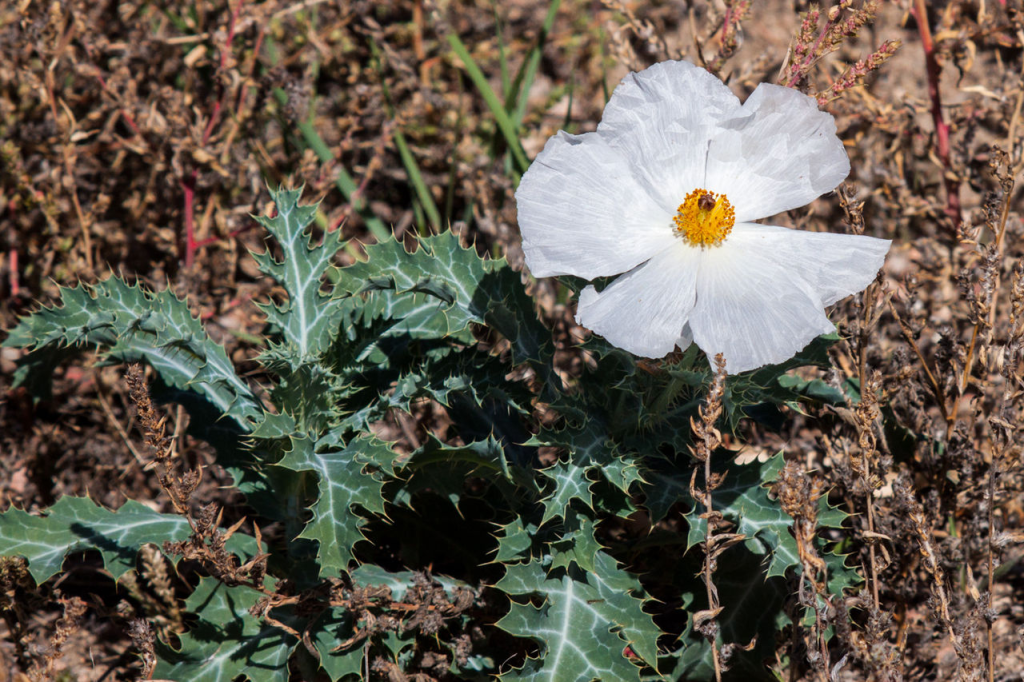
Also known as bluestem prickly poppy, white prickly poppy, annual prickly poppy and thistle poppy, this wildflower is native to grassland, foothills of North Dakota, South Dakota, Nebraska, Kansas, Iowa, and Indiana as well as places in the Southwest and Rocky Mountain area. It grows up to 4′ tall and has grayish green leaves that are up to 8″ long, deeply lobed and are prickly on the margins and lower surfaces. From spring into summer, flowers appear that are 3-4″ across and have 4-6 crinkled white petals surrounding a center of yellow stamens. All parts of the plants are poisonous.
Type: Annual or perennial
Height: 2-4′
Bloom time: Spring into summer
Bloom Color: White with yellow center
Light: Full sun
Soil: Average, dry to medium, well-drained; tolerates lean gravelly or sandy soil, and drought
USAD Hardiness Zones: 2-11
Photo Credit: WideClyde, Wikimedia Common
The Midwest includes the states of Ohio, Indiana, Illinois, Iowa, Kansas, Missouri, Michigan, Wisconsin, Minnesota, Nebraska, South Dakota, and North Dakota. The area features lakes, mountains, and vast fertile plains that are the “bread basket” of the nation. The climate of the Midwest has great variations in temperatures with hot humid temperature averaging 85-95 F in summer and winter temperatures often falling below 0 F. Precipitation comes in the form of both rain and snow and varies from 43.6″/year to 18.8″/year.