
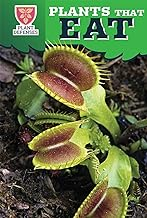
Plants that Eat Meat, by Keisha Jones, introduces young readers to carnivorous plants and the methods they use to obtain prey. Written for children 1-9 years old in grades 3-4, the book shows that a plant’s ability to eat meat is an adaption to their environment that allows them to survive under challenging conditions. The characteristics of four carnivorous plants are described in some detail.
A discussion of the general characteristics of meat eating plants is followed by profiles of Venus fly trap, sundew, butterworts, and sundew plants. Jones points out that meat-eating probably arose among plants that lived in habitats that were low in nitrogen and needed to consume animals to provide the missing element. We learn that there are over 600 different kinds of meat-eating plants and that most are small. Although all of these plants eat meat they trap their prey differently. While some carnivorous plants passively produce a substance to attract the prey to their death, others actively close around their prey’s body. The profiles of specific carnivorous plants reveal that Venus flytrap only digests its prey if the hairs on it lobes are brushed more than three times, bladderworts can digest their prey in 15 minutes, and the world’s largest pitcher plant can digest a rodent. Jones further suggests that the meat-eating habits of carnivorous plants might be a form of defense. A glossary, index, and website for more information concludes the work.
The text is written in a simple, clear style and and photographs are used to enhance comprehension. Scientific facts are simplified but simple basic vocabulary like habitat, photosynthesis, and environment is introduced. Plants that Eat Meat is a valuable resource for promoting the value of diversity in nature and an appreciation of the natural world.
To buy Plants that Eat Meat from Amazon, click here.
This information-rich volume explains how being carnivorous is actually a defense, and how it helps these special plants survive. Colorful images and age-appropriate language explain important science concepts, which are presented in a way that’s designed to complement classroom learning
7 – 9 years grades 3-4
 Karen
Karen