
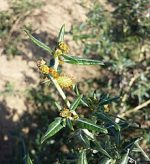
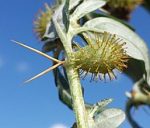
Also known as prickly burweed and spiny cocklebur, bathhurst burr is an annual that is possibly native to South America but found in disturbed habitats such as pastures, crops, grasslands, and floodplains of temperate areas around the world. It is a member of the aster family, Asteracaea, that also includes daisy, yarrow, and lettuce. The much branched plants have slender stems that are striated, yellowish or brownish gray, and 3′ or more long. The spirally or alternately arranged leaves are lanceolate or irregularly lobed, entire and about 1-3″ long. They are silvery beneath and dull gray-green above with a conspicuous white midrib. A yellow, three pronged spine about 1-2″ long grows in the axils of the leaves. Inconspicuous male and female flowerheads consisting only of disc florets appear on the same plant during the summer into late fall. The male flowers are in dense terminal clusters near the topmost leaves while the female flowerheads are axillary among the lower leaves. Pollinated female flowers develop into egg-shaped yellowish burrs about .5″ long that are covered with small hook-like spines. Each burr contains two slightly flattened, thick-coated seeds. The burrs float on water and readily attach to clothes, the fur of animals, and other objects, which facilitates dispersal. Although bathhurst burr has been used medicinally to treat a variety of ailments it is considered a noxious weed in many agricultural crops and is toxic to most domestic animals, especially swine and horses. The genus name, Xanthium is derived from the Greek word, xanthos, meaning yellow and may to refer to a yellow dye obtainable from some species. The specific epithet, spinosum, is the Latin word meaning spines. Photo Credit Wikipedia
Type: Annual
Bloom: Clusters of inconspicuous greenish male and female flowers on the same plant from summer to late fall
Size: Up to 3.3′ H x up to 59″ W
Light: Full sun
Soil: Average, medium moist, well-drained but tolerates less
Hardiness: Not applicable
Care: Prolific seed production and easily dispersal methods suggest careful attention to prevent invasiveness.
Pests and Diseases: Numerus insects, fungi and bacteria infect Xanthium spp including Puccinia xanthii, Colletotrichum xanthii, Erysiphe cichoracearum, Verticillium dahliae, Oedopa capito
Propagation: Seed
Companion Plants: Not applicable
Photo Credit: Wikipedia
 Karen Meyers