
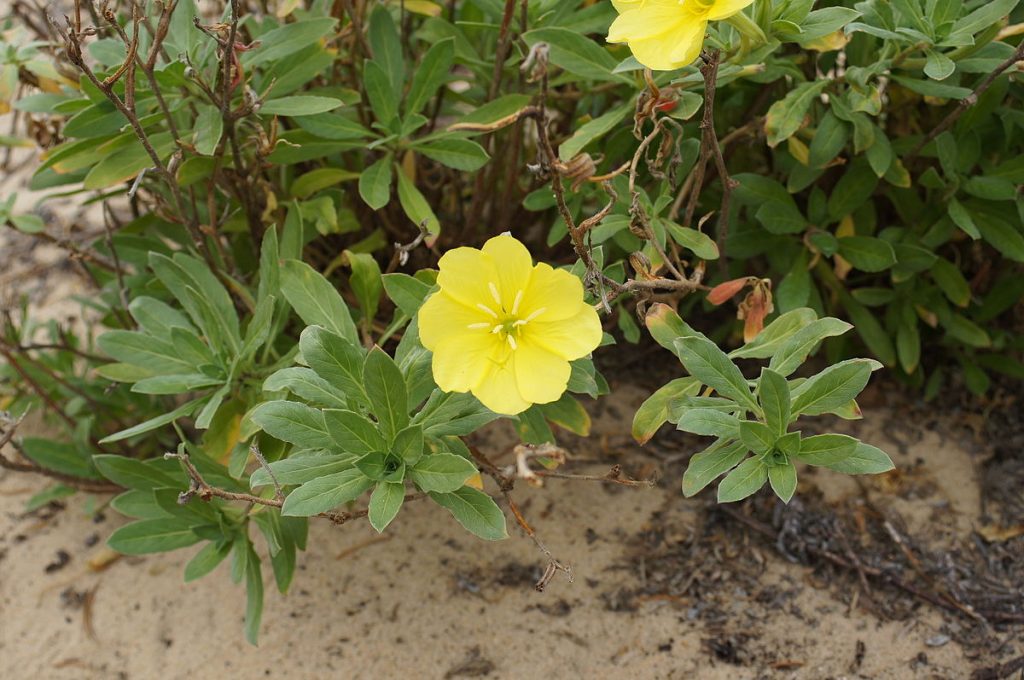
Native to sandy beaches of northern Mexico and south-eastern US, this herbaceous perennial is a member of the willowherb family, Onagraceae, that also includes fuchsia, fireweed, and Clarkia. The plant grows ½” -1 ‘ tall and spreads by seed to form a mat 1-2 ft. wide. The stems may be branched and carry gray- to blue-green leaves that are up to 1.6″ long and are elliptic, oblanceolate, or obovate. The terminal, solitary 4-petaled flowers appear from spring until fall and are white to yellow and up to 3″ wide. They open in the evening for just one day. The plants attract both butterflies and bees. Highly salt tolerant, beach evening primrose is valued for erosion control and dune stabilization projects and is a useful groundcover in seaside gardens. The genus name, Oenothera, is from the Greek words, oinos meaning wine and thera, meaning booty or wine catcher referring to the belief that the root when eaten increased a person’s capacity for wine. The specific epithet, drummondii, honors Thomas Drummond (1790-1835), a Scottish naturalist.
Type: Herbaceous perennial
Bloom: White to yellow flowers from spring to fall
Size: 1/2″-1′ H x 1-2′ W
Light: Full sun
Soil: Sandy, dry to medium moist, well-drained
Hardiness: Zones 8-11
Care: Low maintenance
Pests and Diseases: None of significance
Propagation: Division, seed
Companion Plants:
Outstanding Selections: None available
Photo Credit Harry Rose Wikimedia Commons