
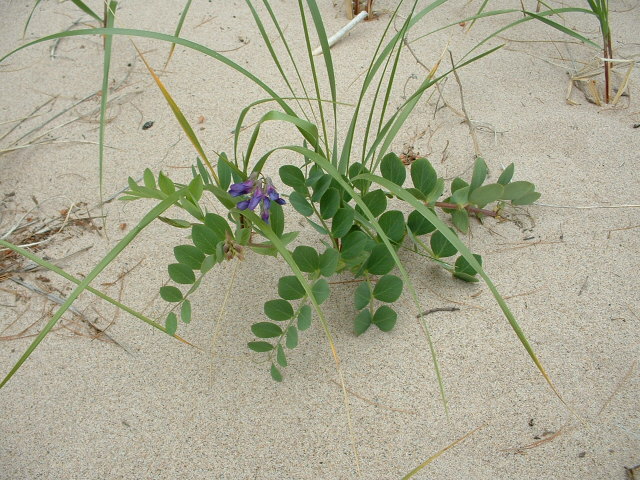
Also called sea pea, circumpolar pea or sea vetchling, this herbaceous perennial vine is native to coastal areas of temperate Europe, Asia, North and South America. It is a member of the legume family, Fabaceae, that also includes peas, lupines, and black locust. The multiple unbranched stems grow from a rhizomatous root system and are 6-24″ long and carry waxy, gray-green leaves that are 20-31″ long and pinnatley compound with 2-5 pairs of narrow lanceolate leaflets, often with a twinning tendril at the tip. Large, arrow-shaped stipules subtend the leaf petioles. From mid- to late summer long racemes of 5-12 flowers appear on long stems from the upper leaf axils. Each flower is less than 1″ long and has a dark purple standard, and paler purple wing and keel petals. The flowers are attractive to bees and butterflies while the 2″ long flat brown seed pods provide food for deer, mice and birds. Beach pea seeds survive in salt water for up to 5 years and germinate when the seed coat is opened by abrasion with sand. The plants are valued for dune restoration because their roots bind the soil and stabilize the dunes. They are a good choice for seaside, butterfly, and wildlife gardens. The genus name, Lathyryus, is from the ancient Greek λάθυρος (láthuros) meaning composed of , the prefix la- meaning very , and the suffix –thyros meaning passionate. The specific epithet, japonicus, is the Latinized form of Japan referring to one of the places where the plant is native.
Type: Herbaceous perennial vine
Bloom: Racemes of small purple flowers with standard, wing and keel from mid to late summer
Size: 6-24″ long
Light: Full sun
Soil: Sandy, moderately moist to dry, well-drained
Hardiness: Zones 3-7
Care: Low maintenance
Pests and Diseases: None of significance
Propagation: Seed with 24 hour soaking in warm water
Companion Plants: American dune grass, sea rocket, seabeach sandwort
Outstanding Selections: None available
Photo Credit: Wikipedia