
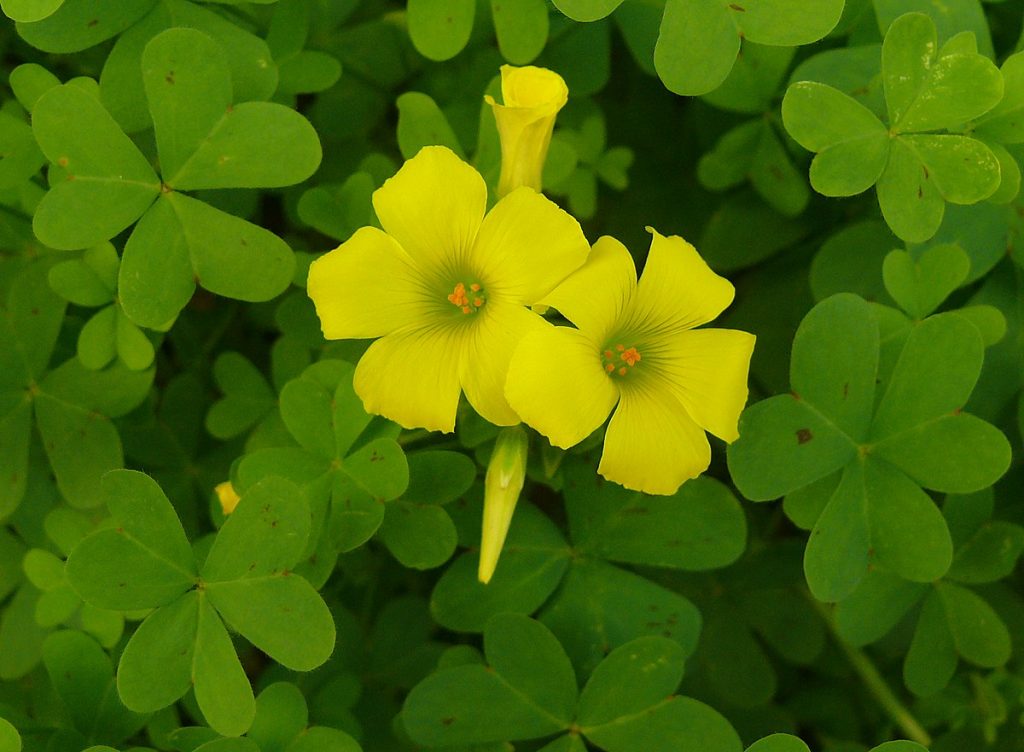
A member of the wood-sorrel family, Oxalidaceae, Bermuda buttercup is a herbaceous perennial also known as buttercup oxalis, Cape sorrel, English weed, goat’sfoot, sourgrass, and soursob. It is indigenous to the Cape region of South Africa but is widely distributed in other parts of the world especially in Mediterranean climates. The plant grows about 8″ tall from a bulb about 1″ across and has a short stem that gives rise to a loose basal rosette of light green shamrock-like leaves 1.25″ across on petioles less than 4.7″ long. Each leaf is composed of 3 leaflets that are less than 1.5′ long, often had red-brown splotches, and have a hairy lower surface. In spring, umbels of less than 20 flowers appear. Each flower is 1.5″ across and has 5 lanceolate sepals tipped with 2 orange or yellow tubercles, and 5 clawed, yellow petals that are less than 1″ long. Fruits and seeds are not usually produced outside South Africa and the plants multiply by producing up to 20 bulblets each year. Although considered rare and endangered in its native habitat, and is considered invasive in coastal California where it grows in coastal dunes, scrub, oak woodlands, gardens, turf, urban areas, orchards and agricultural fields. The genus name, Oxalis, comes from the Greek word oxus meaning sour, and refers to the sour taste of the leaves and stem. The specific epithet, pes-caprae, are the Latin words for foot of a goat and perhaps refers to the shape of the leaf.
Type: Herbaceous perennial
Bloom: Umbels of yellow flowers in spring
Size: 8-12″ H x 12″ W
Light: Full sun; tolerates some shade depending on the site
Soil: Average, moderately moist to dry, well-drained
Hardiness: Zones 8-11
Care: Controlling spread is difficult
Pests and Diseases: None of significance
Propagation: Bulblets
Companion Plants: Rain daisies (Dimorphotheca pluvialis), gousblom (Arctotis hirsuta)
Outstanding Selections: None available
Photo Credit: MathKnight and Zachi Evenor Wikimedia Commons