
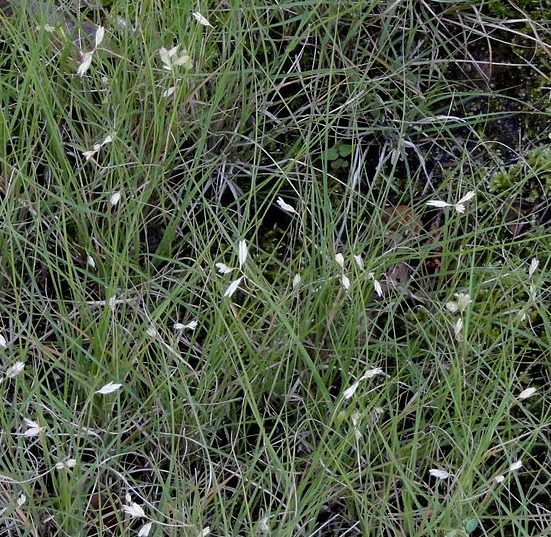
This warm season perennial short grass is native to North America where it is a component of the short grass prairie. It is a member of the grass family, Poaceae, that also includes corn, rice, and bamboo. Spreading by rhizomes, the plants grow 3-12″ tall and have soft, fine-textured, gray-green to blue-green foliage that curls to create a handsome turf. Inconspicuous male and female flowers are appear on different plants from spring to fall. The male flowers are on small, comb-like spikes just above the foliage, while female flowers are in bur-like clusters on short stems down in the leaves. From mid fall to mid spring, and during times of drought, the plants turn brown. Tolerant of low fertility, drought, heat, and alkaline soil, buffalo grass is easy to grow, and has has been bred for both turf and forage. When used for a lawn it is equally attractive mowed 2-3″ tall or allowed to grow long and billow naturally. Buffalo, white tailed deer, and prairie dogs eat the foliage, early settlers used the turf to build sod houses, and the plants are a larval host for green skipper butterflies. The genus name, Buchloe, comes from the Greek words bous, meaning cow or ox and chloe, meaning grass. The specific epithet, dactyloides, comes from the from the Greek dactylus meaning finger and –oides meaning like or resembling, and refers to the arrangement of the branches of the flower head like the fingers of a hand.
Type: Warm season perennial grass
Bloom: Inconspicuous male and female flowers on the different plants, spring through fall
Size: 3-12″
Light: Full sun
Soil: Average to lean, medium moist to dry, well-drained; tolerant of drought and alkaline conditions
Hardiness: Zones 4-8
Care: Mow or allow to grow long
Pests and Diseases: False smut, aphids
Propagation: Seed, division
Companion Plants: Blue gama and oats as a covercrop
Outstanding Selections:
‘Density’ (lawn)
‘Prairie’ (lawn)
‘609’ (lawn)
‘Stampede’ (lawn, 4″ tall)
‘Texoka’ (forage)
‘Comanche’ (forage)
Photo Credit: Daderot Wikimedia Commons