
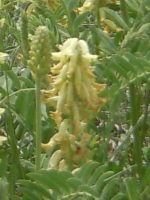
Also known as rattle weed, this herbaceous perennial is a member of the pea family, Fabaceae, that also includes lupines, mimosa, and black locust. It is native to most of North America where it grows in a variety of habitats including woodlands, prairies, thickets, moist meadows, stream banks, abandoned fields and roadsides. Growing 1-4′ tall from a tap root with rhizomes, the plant has branching stems and pinnately compound leaves that are 5-9″ long and have 21-31 oblong leaflets 1.5″ long. In summer, 6″ long terminal racemes carry up to 75 greenish to cream colored flowers in whorls. Each pea-like flower is tubular, 3/4″ long, and has of 5 petals. The oval seed pod is two chambered, 1/2″ long, and pointed at one end with the remnants of the style adding a tail-like appearance. Nectar provides food for bumblebees and honey bees while the foliage is a food source for wildlife such as wild turkeys, deer, rabbits, and small rodents. Canada milkvetch is a good choice for a wildlife garden and the flowers are good in the vase. The genus name, Astragalus, is the Greek name for a leguminous plant. The specific epithet, canadensis, is the Latinized form of Canada and refers to the distribution of the plant in North America.
Type: Herbaceous perennial
Bloom: Terminal racemes with whorls of pea-like greenish to cream colored flowers in summer
Size: 1-4′ H x 2′ W
Light: Full sun to part shade
Soil: Average, medium moist, well-drained
Hardiness: Zones 3-8
Care: Low maintenance
Pests and Diseases: None of significance
Propagation: Seed
Companion Plants: Rough blazing star, big bluestem, leadplant
Photo Credit: Wikipedia