
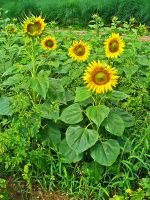
Although there are many perennial sunflowers there is only one annual that is garden worthy but that one has dozens of cultivars and is very popular. A native of western US, common sunflower is a member of the aster family, Asteraceae, that also included daisy, yarrow and lettuce. Plants are highly branched and can grow up to 10′ tall but are usually 3-7′. The stems have small stiff hairs and carry alternate leaves that are rough hairy, broadly oval to heart-shaped, and coarsely toothed. From mid summer to fall flowerhead appear that are up to 12″ across and consist of yellow ray flowers surrounding a center of purple or red disc flowers. Cultivars offer variations in flowerhead color, size and fullness as well as plant height. The flowers are attractive to butterflies and bees and the seeds are eaten by birds and mammals including humans. Plants are grown for their oil, and as wild bird food livestock forage, and for cut flowers. Common sunflowers are attractive in borders, and meadow, prairie, cottage, butterfly, wildlife, and cutting gardens. They make a strong statement especially when tall but the domesticated ones usually produce just a single large flowerhead per unbranched plant. Once the that one flower is finished blooming the plant deteriorates quickly and should be removed from the garden with the flowerhead saved for the birds and other wildlife. The genus name, Helianthus, comes from the Greek words helios, meaning sun, and anthos meaning flower and and may refer to the resemblance of the flowerhead to the sun. The specific epithet, annus, is the Latin word meaning year, and refers to the life cycle of the plant.
Type: Annual
Bloom: Flowerheads with yellow, orange, red, creamy white ray flowers surrounding a center of red to purple or brown disc flowers, in summer
Size: 3-10′ H x 18-36″ W
Light: Full sun
Soil: Average, moderately moist, well-drained, neutral to alkaline
Hardiness: Not relevant
Care: May need staking
Pests and Diseases: Downy mildew, Fusarium
Propagation: Seed
Companion Plants: Fountain grass, golden marguerita, sea holly
Outstanding Selections: Large number available but here are some excellent ones:
‘Teddy Bear’ Double yellow flowers, dwarf plant)
‘Valentine’ (6″ wide, lemon yellow ray flowers on well branched medium plant under 5′ that rarely needs staking)
‘Lemon Queen’ (creamy pale yellow ray flowers around a large brown disc on plant over 5′)
Photo Credit: Wikipedia
 Karen Meyers