
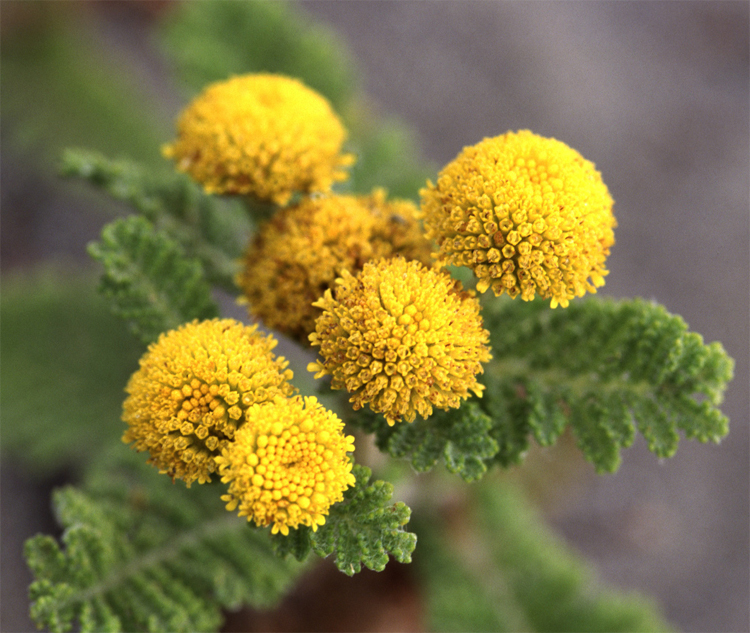
Also known as camphor tansy, this herbaceous perennial is native to the Pacific Coast of North America from British Columbia to Northern California where it grows on sand dunes and in other coastal habitats. It is a member of the aster family, Asteraceae, that also includes sunflower, goldenrod and lettuce. The plant grows 4-24′ tall and forms colonies with thick branching stems and a rhizomatous root system. The thick, fern-like, gray-green leaves are up to 10″ long and twice or thrice divided into leaflets with edges curled under and covered with glands. From summer into fall, clusters of 3-15 flowerheads appear. Each flowerhead is button-shaped, .4-1″ across, and composed of many yellow disc florets surrounded by many pistillate florets and sometimes a few tiny ray florets. The fruit is an tiny achene tipped with a small pappus. The plant is hairy and aromatic with a camphor-like scent. Considered a rare plant, dune tansy is an attractive groundcover and useful for erosion control but can be aggressive. The genus name, Tanacetum, is from the Greek prefix a- meaning not, and thanatos meaning death probably referring to the plant’s persistence. The specific epithet, camphoratum, is from the Medieval Latin word camfora, the name given to a whitish, volitile substance with a penetrating odor, and refers to the scent of the plant.
Type: Herbaceous perennial
Bloom: Yellow flowerheads from summer into fall
Size: 4-24″ H
Light: Full sun
Soil: Sandy, dry, well-drained; drought resistant
Hardiness: Zones 10-11
Care: Cut by half in the fall to maintain form; contain when necessary
Pests and Diseases: None of significance
Propagation: Division, seed
Companion Plants: Ceanothus, sand verbena, beach bur
Photo Credit: Gordon Leppig & Andrea J. Pickart Wikimedia Commons