
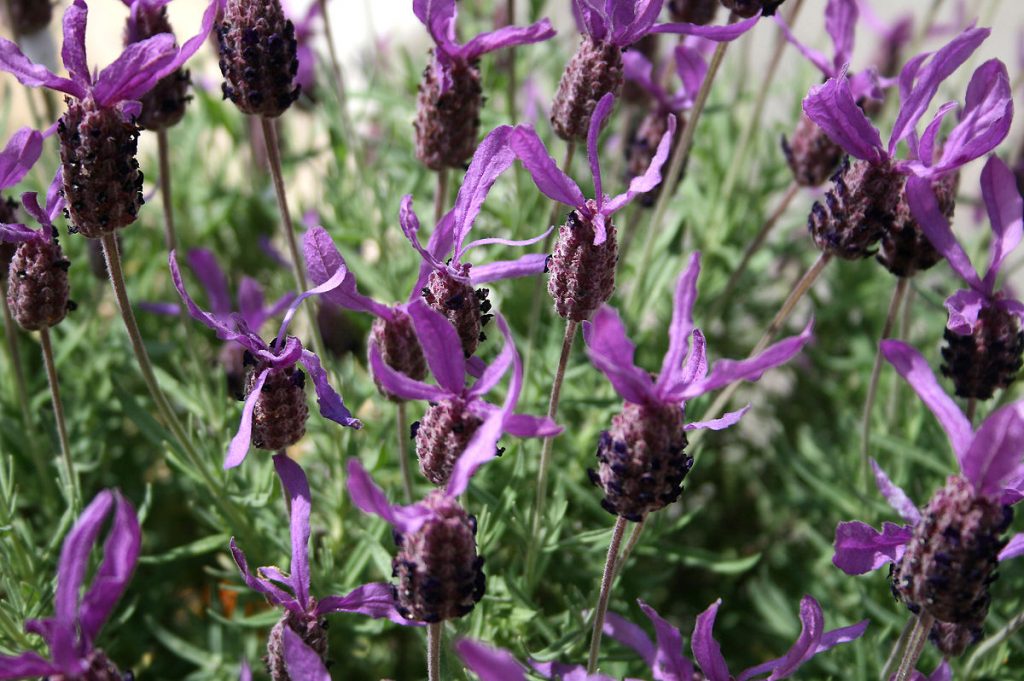
Also known as Spanish lavender, butterfly lavender, and topped lavender, this evergreen shrub is native to areas in the Mediterranean including Portugal, Spain, France, Italy and Greece. It is a member of the the deadnettle family, Lamiaceae, that also includes mint, rosemary, and beebalm. The plants grow to about 3′ tall and have silver stems that are square in cross section. Velvety, gray-green leaves are 1-3″ long and very aromatic. From mid spring to mid summer, spikes of pink to dark purple flowers appear on leafless stems. The spikes are 3/4″ long and topped with four lighter purple bracts that resemble flags or ears. The flowers are attractive to bees and butterflies. French lavender is one of the earliest lavenders to bloom but is less hardy than its more familiar cousin, English lavender. It is a good choice for a hedge or border in Mediterranean, cottage, and rock gardens, and grows well in a container. The leaves are especially valued for potpourris and the flowers are attractive in the fresh and dried arrangements. The genus name, Lavendula, comes from the Latin word lavo meaning wash and refers to the use of the plant is in toiletries. The specific epithet, stoechas comes from the Greek stoichas meaning in rows.
Type: Evergreen shrub
Outstanding Feature: Flowers
Form: Round
Growth Rate: Slow
Bloom: Spikes of pink to dark purple flowers topped with dark purple bracts from mid spring to mid summer
Size: 2-3′ H x 2-3′ W
Light: Full sun
Soil: Lean, dry to medium moist, well-drained, slightly alkaline
Hardiness: Zones 6-11
Care: Shear lightly after flowering to promote bushiness; do not cut to the ground.
Pests and Diseases: None of significance
Propagation: Cuttings, division, seed
Outstanding Selections:
‘Alba’ (white flowers)
‘Anouk’ (dark plum flower heads with blue-violet bracts)
‘Ballerina’ (bi-color purple flowers with white flags)
‘Purple Ribbons’
Photo Credit: Jean-Pol Grandmont, Wikimedia Commons