
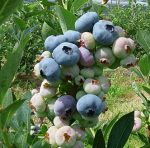
This deciduous shrub is known by several names including blue huckleberry and swamp huckleberry and is a member of the heath family, Ericaceae, that also includes heather, cranberries, and azaleas. It is native to eastern Canada and eastern and southern US from Ontario and Nova Scotia to Florida and eastern Texas where it grows in bogs, swamps, and high elevation forests with acidic soil (pH 4.5-5.5). Plants grow 6-12′ tall and have elliptical, 2″ long leaves that are reddish-green in spring, blue-green in summer with lighter undersides, and turn red, yellow, orange and purple in the fall. Deer and rabbits browse the foliage. In spring, plants produce clusters of urn-shaped, pale pink flowers that are 1/3″ long and have fused petals. Edible blue-black berries 1/4-1/2″ in diameter appear in the fall and are attractive to birds, small mammals, and bears. Highbush blueberry is a good choice for fruit production, a hedge, border, wildlife and native plant gardens. The genus name, Vaccinium, is the ancient Latin name for the genus and of unknown origin. The specific epithet, corymbosum, refers to the infloresecence, a corymb.
Type: Deciduous shrub
Outstanding Feature: Edible berries, fall coloration
Form: Rounded
Growth Rate: Slow
Bloom: Clusters of urn-shaped, plae pink flowers in spring
Size: 3-12’H x 3-10′ W
Light: Full sun to partial shade
Soil: Average, medium moist to wet, well-drained, acidic (pH4.-5.5 depending on the cultivar)
Hardiness: Zones 5-8
Care: The first two years after transplanting remove flowers to promote root and shoot growth. Beginning in the third year prune in late winter to shape.
Pests and Diseases: Spotted wing drosophila, birds, deer; stem blight, root rot, anthracnose, cane cankers, mildew, botrytis, mummy berry
Propagation: Seed, stem cuttings
Outstanding Selections: Many outstanding varieties are available
Photo Credit: Blueberry Glade, Wikipedia
 Karen Meyers