
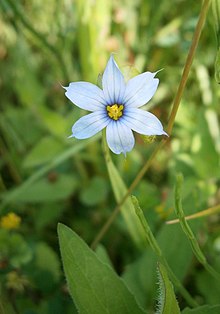
Native to moist meadows and woodlands of North America, this semi-evergreen herbaceous perennial is not a grass but is in the iris family, Iridaceae, that also includes gladiolus, crocus and freesia. The plants grow 18-24″ tall and form loose tufts of narrow, light green, grass-like leaves up to 12″ long. From late spring into summer, flattened, branched, broadly winged stems bear few flowered clusters of star-shaped flowers. The flowers are up to 1/2″ across and have a yellow eye and 6 blue tepals that are tipped with a sharp point. The plants are short-lived but tend to self seed and are a good choice for informal settings such as woodland, cottage, wildflower, and native plant gardens. The genus name, Sisyrinchium, may come from the Greek sys-, meaning pig, and rynchos , meaning snout, referring to the roots being consumed by swine. The specific epithet, angustifolia, comes from the Latin words angustus meaning narrow, and folium meaning leaf.
Type: Semi-evergreen herbaceous perennial
Bloom: Few-flowered clusters of flowers with yellow eye and 6 blue tepals in late spring to summer
Size: 18-24″ H x 6-12″ W
Light: Full sun to partial shade
Soil: Fertile, consistently moist, well-drained
Hardiness: Zones 5-9
Care: Tidy up plant by removing declining foliage after flowering; divide every 2-3 years to maintain vigor.
Pests and Diseases: None of significance
Propagation: Division, seed
Companion Plants: Carpet bugle (Ajuga reptans), bloody cranesbill (Geranium spp), prairie smoke (Geum triflorum)
Outstanding Selection: ‘Lucerne’ (more and larger flowers)
Photo Credit: Wikipedia
 Karen Meyers