
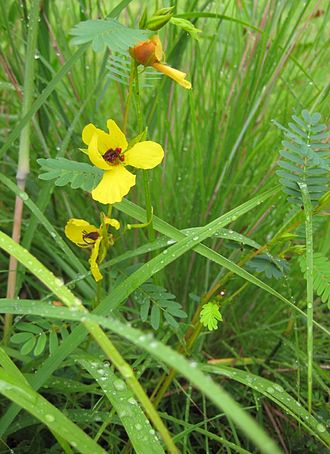
Also known as prairie senna, golden cassia, large-flowered sensitive pea, sleeping plant, and locust weed, this herbaceous annual is native to open woods, meadow, prairies and plains of eastern US. It is a member of the legume family, Fabaceae, that also includes beans, lupine, and black locust. The plants grow 1-3′ tall from a short taproot and are erect if short but sprawl if tall. The feathery leaves are pinnately compound with 8-18 pairs of linear to oblong leaflets that are 2/3″ long. The petioles of the leaves have nectaries that attract several insects including sweat bees, flies, wasps and ants. The leaves fold up in the evening or when touched. In summer, clusters of 2-6 1″ wide flowers appear in the upper leaf axils and have 4 yellow stamens, 6 red stamens, and 5 yellow, rounded petals with a reddish purple spot at the base. The flowers are pollinated by long-tongued bees such as bumblebees, honey bees, long-horned bees, and leafcutting bees and are also a good food source for butterflies. The fruit is a flat green pod 1.5-2.5″ long, that ripens to brown, opens on 2 sides, and explosively expels the seeds inside. The seeds are eaten by field mice, and both song and game birds. The plants provide cover for wildlife, browse for deer, and serve as a larval host to the sulfur butterfly. Partridge pea, like other legumes, fixes nitrogen in the soil and is valued for for erosion control, and soil reclamation and stabilization. It is also grown for honey and as an ornamental in informal gardens such as meadow, prairie, wildlife, butterfly, or native plant gardens. Plants self seed and can become weedy. The genus name, Chamaecrista, comes from the Greek words chamae meaning low growth and crista meaning crested. The specific epithet, fasciculata, is from the Latin word fasces meaning bundle and is related to the sensitivity of the leaves.
Type: Herbaceous annual
Bloom: Small clusters of yellow flowers in summer
Size: 1-3′ H x 1-3′ W
Light: Full sun; tolerates some shade
Soil: Average to lean, dry to moist, well-drained
Hardiness: Zones 3-9
Care: Low maintenance
Pests and Diseases: Generally healthy but susceptible to damage by mildew and leaf spot
Propagation: Seed
Companion Plants: Purple cone flower, black eyed Susan, butterfly weed
Photo Credit: Wikipedia