
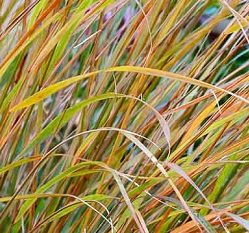
Also known as New Zealand wind grass and gossamer grass, this semi-evergreen perennial grass is native to New Zealand and is a member of the grass family, Poaceae, that also includes corn, rice, and bamboo. It grows 2-3′ tall and forms clumps of narrow arching leaves that are dark green at first but takes on gold, copper and red coloration when stressed by lack of moisture or cool temperatures. In late summer, airy, arching sprays of pendent red flowers appear and persist into winter along with the foliage. Pheasant tails grass provides color, movement and structure in the garden and can be used in borders and cottage, meadow, prairie, and coastal gardens as well as in containers. It does especially well on the coast of Northern California, Oregon, and Washington (but not in Southern California). The genus name, Stipa, is the Latin word from the ancient Greek word στύππη meaning fiber. The specific epithet, arundinaceae, is from the Latin arundo meaning reed and aceus meaning resembling, referring to the reed-like characteristics of this grass.
Type: Semi-evergreen perennial grass
Bloom: Airy, arching clusters of pendent red flowers in late summer
Size: 2-3′ H x 2-3′ W
Light: Full sun to light shade
Soil: Moderately fertile, medium moisture, well-drained
Hardiness: Zones 8-12
Care: Clean out dead foliage in early spring
Pests and Diseases: None of significance
Propagation: Seed, division in mid summer to early summer
Companion Plants: Nicotiana alata ‘Lime Green’, lupine, Achillea millefolium
Photo Credit: Wikipedia