
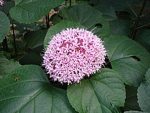
Also called, Mexican hydrangea, this suckering deciduous shrub is native to China, Vietnam, and Taiwan where it grows along roadsides and on mountainous slopes of mixed forests. It is a member of the deadnettle family, Lamiacea, that also includes beebalm, adjuga and mint. Plants grow up to up to 6′ tall and have oval leaves up to 12″ long with coarsely toothed margins. The leaves are dark green above, fuzzy bronze-green below, and give off an unpleasant odor when crushed. The rosy red, trumpet-shaped flowers are 3/4″ wide, and appear in 8″ wide, rounded, terminal clusters from summer into fall. The flowers are fragrant, showy, and attractive to butterflies. Rose glory bower grows rapidly and can become invasive due to its suckering nature so needs a position in the garden where it can be controlled. Plants can be grown in containers and over wintered indoors where not hardy. The genus name, Clerodendrum, comes from the Greek words kleros meaning chance and dendron meaning tree and may refer to the variable medicinal qualities of the plants. The specific epithet, bungei, honors Russian botanist Alexander von Bunge (1803-1890) who is known for his scientific expeditions into Asia, especially Siberia.
Type: Flowering shrub
Outstanding Feature: Flowers
Form: Rounded
Growth Rate: Rapid
Bloom :Eight inch wide terminal clusters of rose red trumpet-shaped flowers from summer into fall
Size: 6′ H x 6′ W
Light: Full sun with light afternoon shade in hot climates
Soil: Fertile, humusy, consistently moist, well-drained; somewhat drought tolerant when established
Hardiness: Zones 7-10
Care: Cut down to the ground in early spring to encourage compactness.
Pests and Diseases: None of significance
Propagation: Division, root cuttings
Photo Credit: Wikimedia Commons
 Karen Meyers