
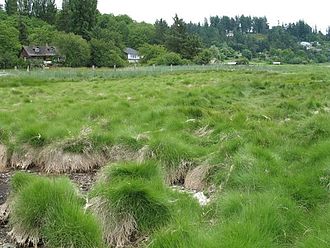
Also known as salt hay, this warm weather perennial grass is native to the Atlantic and Gulf coasts of North America from Newfoundland to Texas where it grows in brackish or salt marshes and flats, coastal beaches and wetland margins. It is a member of the grass family, Poaceae, that also includes corn, rice, and bamboo. The plant grows 1-5′ tall from long slender rhizomes and has weak stems with wiry dark green leaves that are 6-12″ long and rolled so as to appear round in cross section. The plants grow singly or in clumps and often form mats that seem to have cowlicks as the wind and waves bend the weak stems. From summer to mid fall, 3/4-3″ long spikes of tiny, overlapping deep purple florets appear on one side of the stalk. Saltmeadow cordgrass was a natural pasture in pioneer days, and provides cover and food for birds and small mammals. Highly tolerant of salt spray, it is valued for shoreline protection, tidal marsh restoration, and dune stabilization. The genus name, Spartina, comes from the Greek spartine, meaning a cord made from Spartium junceum (Spanish broom), probably referring to the tough leaves and stems. The specific epithet, patens, is from the ancient Greek word πετάννυμι (petánnumi) meaning to spread out, to spread wide.
Type: Warm season perennial grass
Bloom: Spikes of tiny, deep purple florets from summer to mid fall
Size: 1-5′ H
Light: Full sun
Soil: Adaptable to many soil types, moist to wet; very salt tolerant
Hardiness: Zones 4-10
Care: Low maintenance; may become invasive
Pests and Diseases: None of significance
Propagation: Division, seed (plants may produce few seeds)
Companion Plants: Wild rice, phragmites, needle rush, smooth cordgrass
Outstanding Selections:
‘Flageo’
‘Sharp’
‘ Avalon’
Photo Credit: Wikipedia