
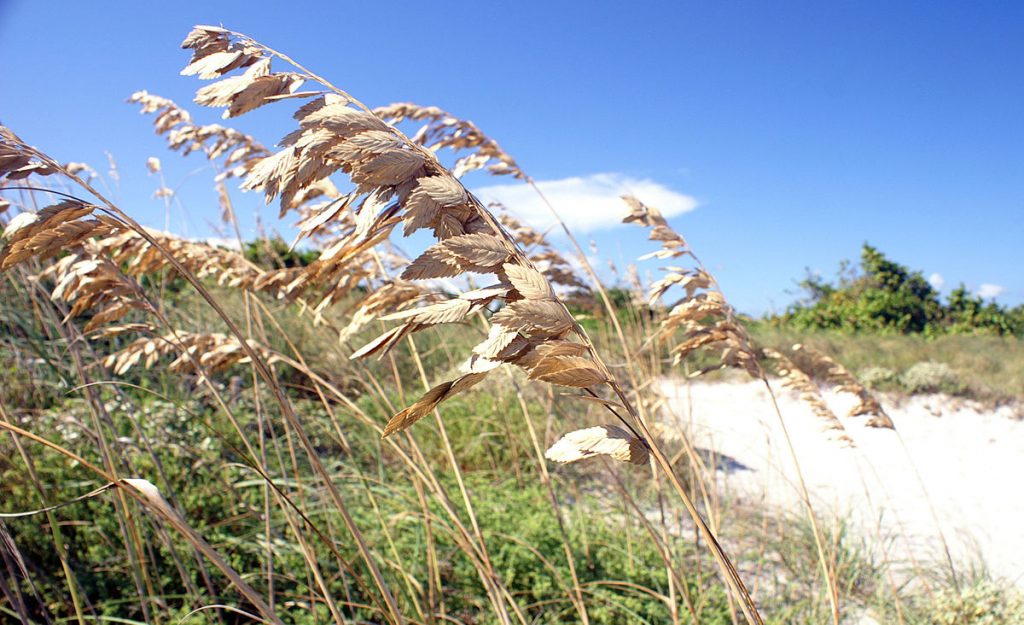
Also known as spike grass, this warm season perennial grass is native to coastal beach communities of North America from Virginia to Florida west along the gulf to Texas and northern Mexico, but is rare and endangered in most areas. It is a member of the grass family, Poaceae, that also includes corn, rice and bamboo. The rhizomatous plants form dense colonies 3-8′ tall consisting of arching, gray-green, somewhat sharp-edged leaves that are 1/4-1/2 ” wide and 8-16″long. Throughout the growing season, long arching stems carry showy panicles of pendent, flat, green flower spikelets that turn brown and persist into winter. The plants are tolerant of moderate drought, heat, wind, and saline conditions but not pollution, foot traffic, or water logged soil. They are valued for stabilizing soil, controlling erosion and providing a habitat for birds and other wildlife. The flowering stems are beautiful in fresh and dried arrangements. The genus name, Uniola, is of uncertain origin but might be derived from the Latin word unus meaning one. The specific epithet, paniculata, is from the Latin word panicula meaning tuft and refers to the inflorescence.
Type: Warm season perennial grass
Bloom: Panicles of pendent, flat, green flower spikelets throughout the growing season
Size: 3-8′ H
Light: Full sun; tolerates light shade
Soil: Sandy, moderately moist, well-drained; some tolerance to drought and saline conditions
Hardiness: Zones 7-10
Care: Low maintenance
Pests and Diseases: None of significance
Propagation: Division
Companion Plants: Railroad vine (Ipomoea pes-caprae), beach morning glory (Ipomoea imperati), beach sunflower (Helianthus debilis), baybean (Canavalia rosea)
Outstanding Selections: None available
Photo Credit: Daniel di Palma Wikimedia Commons