
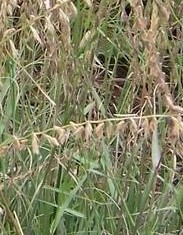
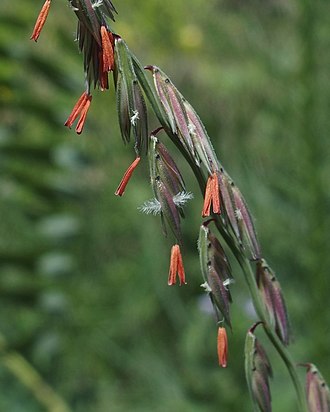
This clump perennial warm-season grass is native to the area from Canada to South America and grows throughout most of the US where it can be found on plains, prairies, and rocky hills. It is a member of the grass family, Poaceae, that also includes corn, rice and bamboo. The plant forms a clump of fine textured, gray-green leaves that turn golden brown in the fall sometimes with orange or red tints . From early to mid summer, oat-like spikelets of flowers appear on one side of the arching flowering stems. The spikelets are purple-tinted at first but mature to tan by fall. The plants provide food and cover for wildlife and the flowering stems are valued for fresh and dried arrangements. Plants are valued as a ground cover and in informal setting such as meadow, prairie, wildflower, native plant, and wildlife gardens. The genus name, Bouteloua, honors the Spanish botanists Claudio (1774-1842) and Esteban (1776-1813) Boutelou y Soldevilla. The specific epithet, curtipendula, comes from the Latin words curtus meaning short and pendulous meaning hanging down, referring to the appearance of the flowering stems
Type: Perennial warm-season grass
Bloom: Purple tinted spikelets on one side of arching flowering stems from early to mid summer
Size: 18-30″ H x 18-24″ W
Light: Full sun
Soil: Average, moderately moist to dry, well-drained; drought tolerant
Hardiness: Zones 4-9
Care: Remove dead foliage in late fall to winter
Pests and Diseases: None of significance
Propagation: Seed (self seeds), division
Companion Plants: Purple cone flower, black-eyed Susan, prairie smoke
Photo Credits: Wikipedia