
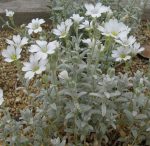
 Native to southern Italy, this short-lived perennial is a member of the carnation family, Caryophyllaceae, that also includes pinks, baby’s breath, and chickweed. The spreading plants form mats of densely hairy, silvery-grey stems and leaves up to 6″ tall. The leaves are lanceolate, up to 1″ long, and evergreen. In early summer, clusters of up to 15 white flowers appear on wiry stems 8-12″ tall. The star-like flowers are up to 1″ across and have 5 deeply notched petals. Snow-in-summer is drought resistant but does best in areas with cool dry summers. It spreads by self-seeding and underground runners and can become invasive but is useful as a groundcover, edging, and xeriscape, as well as in rock, wall, and cottage gardens. The genus name, Cerastium, comes from he Greek word kerastes, meaning horned, and refers to the horned seed capsule of some species. The specific epithet, tomentosum, is the Latin word for densely woolly, with matted hairs, and refers to the stems and leaves.
Type: Short-lived perennial
Bloom: Clusters of white flowers 1″ across in early summer
Size: 6-12″ H x 8-12″ W
Light: Full sun with afternoon shade in hot climates
Soil: Average to lean, dry to medium moist, well-drained
Hardiness: Zones 3-7
Care: Shear after flowering to maintain shape and prevent spread.
Pests and Diseases: Root rot in moist soil
Propagation: Seed, division in spring or fall
Companion Plants: Lady’s mantle, wallflower ‘Bowles Mauve’, creeping thyme
Outstanding Selections:
‘Colmnae’ (4″ mound of foliage)
‘Silver Carpet’ (frosty white foliage; 8″ tall)
‘Yo-Yo’ ( compact, very fine silver foliage, 10″ tall)
Photo Credit: Wikimedia Commons
 Karen Meyers