
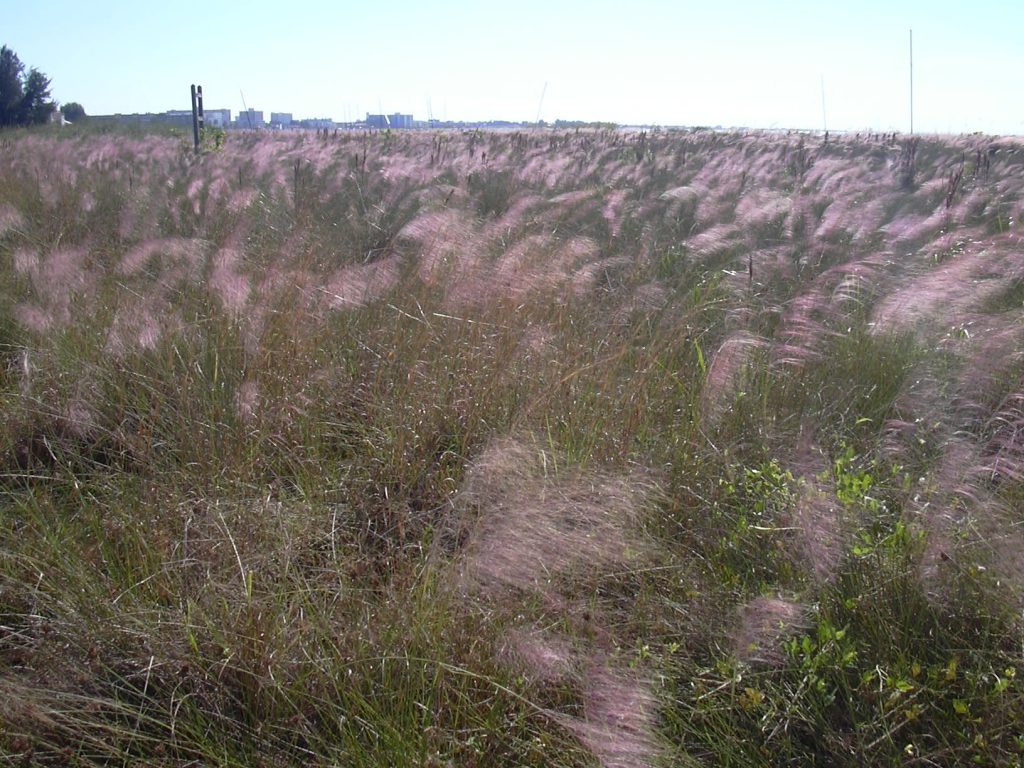
Also known as gulf hairawn muhly, purple muhly, and dune hairgrass, this perennial grass is native to the coastal areas of Southeastern US and is a member of the grass family, Poaceae, that also includes corn, rice, and bamboo. The grass forms clumps of dark green to linear leaves that are 1/2-1″ wide, 13-39″ long, usually with inward rolled margins, and with smooth upper and rough lower surfaces. In the fall, finely branched, elongated panicles 7-24″ long appear with small purplish spikelets.. The over all appearance is like a purplish-pink cloud hovering above the foliage. The plants are beautiful in the border especially in coastal gardens and are suitable for planting on back dunes or between dunes where the roots help stabilize the soil but where the plants will be protected from excessive salt spray and shifting substrate. In addition, the plants attract butterflies, birds, and small mammal, providing food, cover, and nesting sites. The foliage is used in basket weaving and the flowers are beautiful in fresh or dried arrangements. The genus name, Muhlenbergia, honors German-American Gotthilf Heinrich (Henry) Ernst Muhlenberg (1753-1815), a Lutheran minister and botany enthusiast. The specific epithet, filipes, comes from the Latin words filum meaning thread, and pes, meaning foot, and refers to the leaves.
Type: Perennial grass
Bloom: Panicles of pinkish purple spikelets in fall
Size: 2-5′ H
Light: Full sun
Soil: Sandy or rocky, moderate moisture, well-drained
Hardiness: Zones 7-9
Care: Low maintenance
Pests and Diseases: None of significance
Propagation: Seed, division
Companion Plants: Helianthus debilis (Beach sunflower), Helianthus debilis (railroad vine), Ipomoea imperati (beach morningglory)
Outstanding Selections: None available
Photo Credit: Wikipedia
 Karen Meyers