
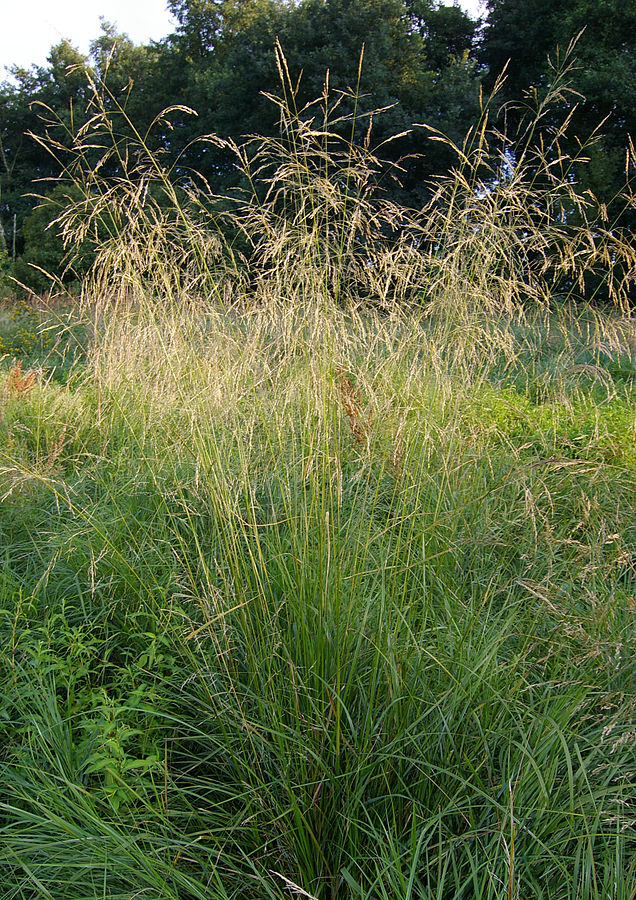
Also known as tussock grass and fairy wand grass, this cool season, semi-evergreen perennial grass is native to eastern and western coasts of North America, parts of South America, Eurasia and Australia and is a member of the grass family, Poaceae, that also includes corn, rice and bamboo. The plants form dense tufts 1-3′ tall of dark green, arching, linear leaves that are 1/8-1/2″ wide and deeply grooved. The upper surface of the leaf blade feels rough and can cut in one direction while being smooth in the opposite direction. During the summer loose airy panicles of green flowers appear 1-3′ above the foliage and mature to yellow, gold, bronze or purple. They are spectacular when backlit! Butterflies, birds, small mammals and grazing animals depend on the grass for food and/or cover, and the flowering stems are attractive in fresh arrangements. Tufted hairgrass is useful as a groundcover and a good choice for garden borders, shade, cutting, native plant, wildlife, rock, meadow, rain, and water gardens. The genus name, Deschampsia, honors Louis August Deschamps (1765-1842) French surgeon and naturalist. The specific epithet, cespitosa, is the Italian word meaning tufted.
Type: Cool season perennial grass
Bloom: Airy panicles of green flowers turning yellow, gold, bronze or purple; summer
Size: 2-4′ H x 1-2′ W
Light: Full sun (with adequate moisture) to part shade
Soil: Rich, moist, soggy to well-drained; some salt saline tolerance
Hardiness: Zones 4-7
Care: Cut back before new growth starts
Pests and Diseases: Aphids, spittlebugs, rust
Propagation: Seed, division
Companion Plants: Carex radiata, Chasmanthium latifolium, Eupatorium coelestinum, Rudbeckia laciniata, ferns, hostas
Outstanding Selections:
‘Fairy’s Joke’ (forms plantlets on flowr spikes)
‘Goldschleier’ (golden yellow flowers; good for mild climates)
‘Goldtau’ (very compact)
‘Schottland’ (especially robust)
‘Tardiflora’ (blooms 2-3 weeks later than species)
Photo Credit: Christian Fischer Wikimedia Commons