
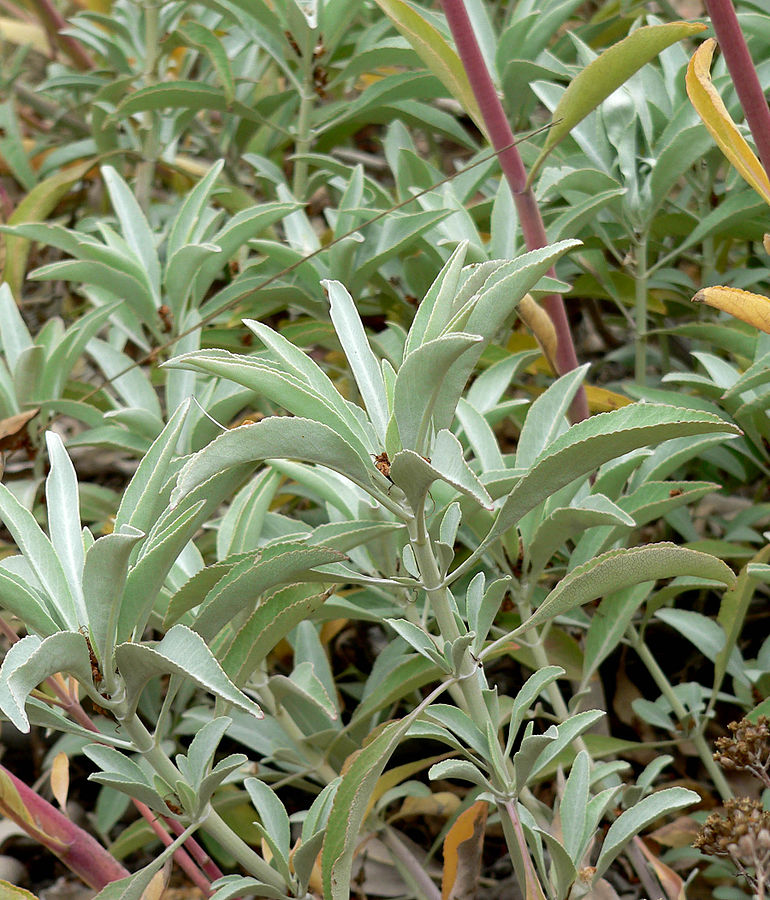
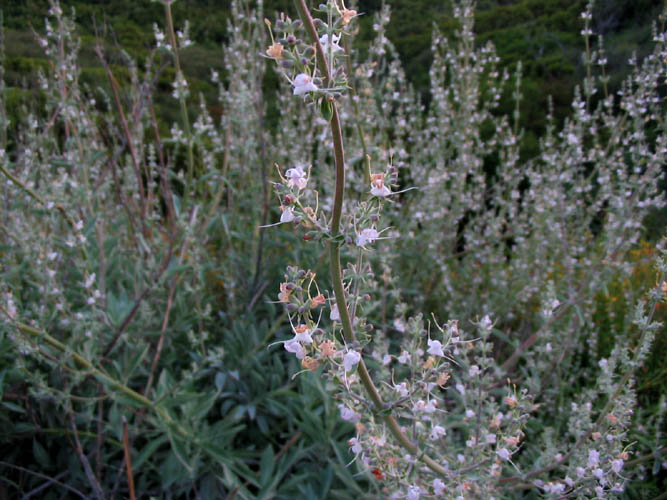
Also known as bee sage, and sacred sage, this evergreen perennial is native to southwestern United States and northwestern Mexico, and is especially associated with the coastal sage scrub and chaparral of Southern California and Baja California. It is a member of the deadnettle family, Lamiaceae, that also includes mint, coleus, and beebalm. The plant grows 3-5′ tall and has soft, silver white, elliptical leaves that are up to 3.5″ long and very aromatic when crushed. In spring and summer, whorls of up to 100 white flowers with lavender spots appear on stems up to 6′ long. The flowers are primarily pollinated by larger bees such as carpenter bees but are an important food source for bumblebees, butterflies, birds including hummingbirds, and other wildlife. White sage is very drought tolerant and a good choice for xeriscaping, a hedge or groundcover, and bank stabilization, as well as for hummingbird, pollinator, butterfly, wildlife, native plant, and moon gardens. The genus name, Salvia, comes from the Latin word salvere, meaning to save and refers to the healing qualities associated with some species of the genus. The specific epithet, apiana, comes from the Latin word apis, meaning bee, and refers to the importance of bees to the pollination of the plant. Photo Credit Stan Shebs Wikimedia Commons
Type: Evergreen shrub
Outstanding Feature: Foliage
Form: Mounding
Growth Rate: Rapid to moderate
Bloom: Wholes of white flowers with lavender spots in spring and summer
Size: 3-5′ H x 3-5′ W
Light: Full sun
Soil: Average to lean, dry to medium moist, well-drained
Hardiness: Zones 8-11
Care: Low maintenance
Pests and Diseases: None of significance
Propagation: Seed in early fall, division
Photo Credit: NPS Wikimedia Commons