
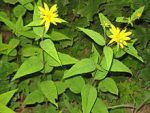
This clump-forming herbaceous perennial is a native of central and eastern North America from Ontario and Quebec south to Florida and Louisiana, and west to Oklahoma and Iowa where it grows in rocky woodlands and dry open sites. It is a member of the aster family, Asteracea, that also includes daisy, yarrow, and lettuce. Plants grow 2-6′ tall and have a rhizomatous root system and smooth branched stems. Sessile lanceolate leaves are 3-6″ long and have serrated margins. From mid summer to fall 1-3″ wide flowerheads appear. Each flower has 8-15 yellow ray florets surrounding slightly darker yellow center disc florets. The flowerheads are attractive to bees and butterflies, the seedheads are attractive to birds, and the flowers are good in the vase. Plants are useful in the back of borders and add color to woodland, cottage, butterfly, wildlife, wildflowers, and native plant gardens. The genus name, Helianthus, comes from the Greek words helios, meaning sun, and anthos meaning flower and may refer to the resemblance of the flowerhead to the sun. The specific epithet, divaricatus, comes from the Latin verb divaricare, meaning to stretch out, and refers to the spreading nature of the plant.
Type: Herbaceous perennial
Bloom: Flowerheads composed of 8-15 yellow ray florets surrounding slightly darker yellow center disc florets.
Size: 2-6′ H x 1-3′ W
Light: Part shade
Soil: Average, dry to medium moist, well-drained
Hardiness: Zones 3-8
Care: Some plants may need staking; divide every 3-4 years to maintain vigor.
Pests and Diseases: Downy mildew
Propagation: Seed, division
Companion Plants: Aster macrophyllus, Carex pensylvanica, Coreopsis lanceolate, Heuchera americana or Solidago caesia
Photo Credit: Wikipedia
 Karen Meyers