
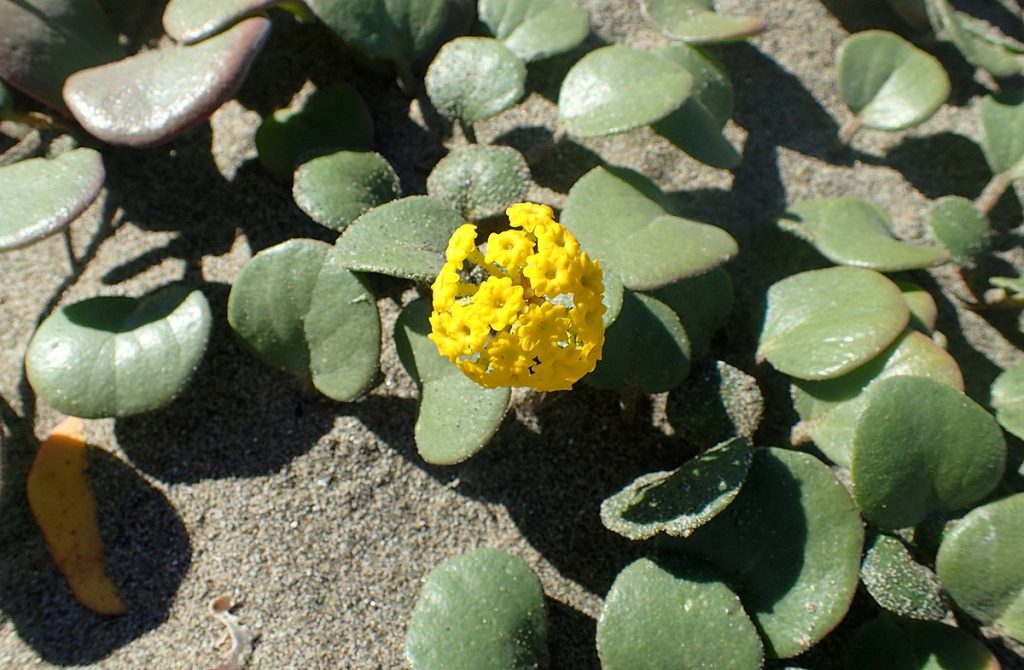
Also called coastal verbena, this herbaceous perennial is native to the west coast of North America from Santa Barbara County, California, to the Canada-US border where it grows on beach dunes and sand dunes of coastal bars, river mouths, and spits along the immediate coastline. It is a member of the four-o’clock family, (Nyctaginaceae) that also includes bougainvillea and is not a true verbena. The plant grows from a spindle-shaped, fleshy, edible roots and has sprawling stems that form 4-5″ tall succulent mats with oval to round, fleshy leaves. From spring through fall, rounded heads of small, fragrant, tubular flowers appear in the leaf axils. The flowers lack petals but have showy bright yellow bracts forming a trumpet-shaped calyx, and are attractive to butterflies and bees. The small fruit is winged. The plants exhibit psammophory, a method of protection that armors them with sand making their bodies less attractive to herbivores. Historically, the roots were eaten by the Chinook Indians and now the plants are valued for stabilizing dunes and controlling erosion. While the plants are very tolerant of salt water and salt spray they are not tolerant of extreme drought. When stressed, the plants will die back but will return when conditions are favorable. Abronia latifolia is valued as a groundcover for seaside, native plant, fragrance, pollinator, and butterfly gardens. The genus name, Abronia, comes from the Greek word abros, meaning delicate. The specific epithet, latifolia, comes from the Latin words latus meaning wide, and folia, meaning leaf.
Type: Herbaceous perennial
Bloom: Rounded heads of bright yellow flowers from spring into fall
Size: 4-5″ H x 7′ W
Light: Full sun
Soil: Sand, medium moist, well-drained, saline
Hardiness: Zones 8-10
Care: Low maintenance
Pests and Diseases: None of significance
Propagation: Seed in autumn
Companion Plants: Common yarrow, beach strawberry, wallflower
Photo Credit: Krzysztof Ziarnek, Kenraiz Wikimedia Commons