
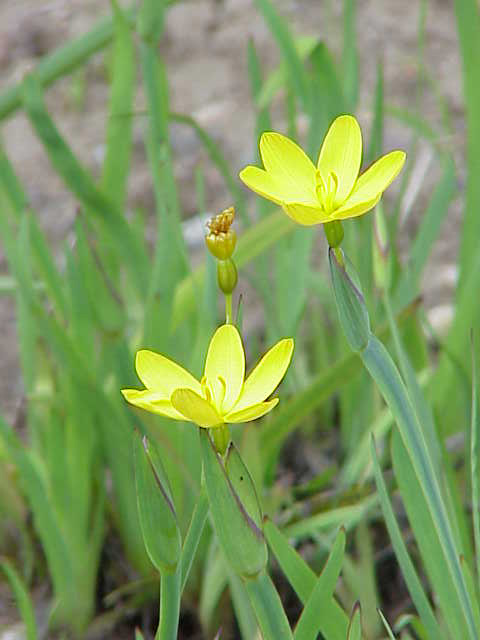
This tender semi-evergreen herbaceous perennial is native to moist soils around ponds, bogs, marshes, and other moist sites along the Pacific coast from central California to southern British Columbia. It is not a grass but is in the iris family, Iridaceae, that also includes gladiolus, crocus and freesia. The plant forms tufts of pale green, grass-like leaves up to 12″ tall and bears star-shaped flowers on leafless stems that are flattened and winged. The flowers appear in late spring to early summer and have 6 pointed yellow tepals that close by noon each day. The fruit is a dark colored capsules with many seeds. The plants usually self seed but are often grown as an annual and are charming additions to informal settings such as cottage, woodland, and wetland gardens, as well as rock gardens and borders with moist soil. The genus name, Sisyrinchium, may come from the from the Greek sys-, meaning pig, and rynchos , meaning snout, referring to the roots being consumed by swine. The specific epithet, californica, refers to the area where the plant is native.
Type: Tender herbaceous perennial
Bloom: Star-shaped flowers with 6 yellow tepals in late spring to early summer
Size: 6-12″ H x 6-8″ W
Light: Full sun; tolerates partial shade
Soil: Average, medium moist to wet; tolerates some dryness
Hardiness: Zones 8-10
Care: Low maintenance
Pests and Diseases: None of significance
Propagation: Seed, division
Companion Plants: California huckleberry, sea thrift, alumroot (Heuchera) species
Photo Credit: Wikipedia
 Karen Meyers