
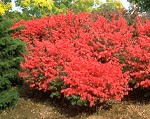
 The bright red color of these shrubs in the fall says it all! Nothing heralds fall more loudly and beautifully than these wonderful bushes that can be planted as a formal or informal hedge, specimen plant, foundation planting, or at water’s edge for their fantastic reflection (but they will not tolerate wet feet.). Also called spindle tree and winged euonymus, burning bush is a deciduous shrub native to China, Japan and Korea and a member of the bittersweet family, Celastraceae. It grows up to 8′ tall and has stems with corky appendages when mature and elliptic to obovate, toothed leaves up to 3″ long. The inconspicuous spring flowers are yellowish green and give way to small red fruits that are 1.3″ long and ripen in the fall. When the capsules open tiny seeds with fleshy orange-red arils (outgrowths) appear and are attractive to some birds. Burning bush has been a very popular plant but is considered an invasive species in some areas. The genus name, Euonymus, is the Latin word meaning ‘of good name’ referring irronically to its being poisonous to animals. The specific epithet, alatus, is the Latin word meaning winged, and refers to the appendages on the mature stems.
Type: Deciduous shrub.
Outstanding Features: Corky appendages on stems; brilliant red foliage in fall.
Form: Upright, vase shaped growth habit when young but spreading horizontally, and becoming layered when mature if not pruned.
Growth Rate: Slow
Bloom: Inconspicuous.
Size: 8’ H x 8’ W.
Light: Full sun to full shade but best color in full sun
Soil: Prefers moist, well-drained, slightly acidic soils, but tolerates poor soils, compacted soils, various soil pHs but not wet feet.
Fertilizer: Apply a general fertilizer in spring (especially important in regard to avoiding/controlling scale.) Alternatively, apply a mulch such as pine, Cyprus or cedar that does not deplete soil nitrogen.
Hardiness: Zones 3-9
Care: Low maintenance
Pests and Diseases: Powdery mildew, scale
Propagation: Rooted stem cutting and seeds.
Alternative Selections: The species, varieties. and cultivars are available; in general, the larger the shrub the less the corkiness on the stems. Varieties also vary in compactness and hardiness.
Comments: Shrubs are slow growing and very tolerant of pruning so can be kept at a desirable size.

About 15 years ago, I planted a row of Winged Burning Bushes. I allway believed that the are very hardy plants. Over the last 3 years, two of the Bushes died (one one year then another 2 years later). After leafing out in spring, the died in late June/early July. But I could see signs of trouble in late May, while the other bushes leaves had come out completely, the sick ones looked like they were just starting to leaf out. I am loosing another one this year.
Any ideas of what may be the prblem??
Thanks,
Steve
Euonymous alatus is a very tough bush so it is surprising to hear that yours are slowly dying off after 15 years. It sounds like over the past 15 years something has changed and you need to identify what the factor is. The first thing I would do is get a soil test. Some states (like North Carolina) do this free through your county extension agent. Give them a call for directions on this. Take a look at your site and see if the drainage patterns have changed. Many shrubs will die as you describe if they have wet feet and new construction in the area or removal of natural vegetation could change the drainage situation adversely. Has there been any dumping of construction waste nearby that could drain into your property? Also look at the light situation although this is less likely to cause the kind of demise you describe. Finally, do you trim your shrubs occasionally? They can get pretty ratty looking and lose vigor if left unattended. A gentle pruning might help them. but the soil and water situations are more probably causes of what you describe so I would focus first on them. Hope this helps.
Karen