
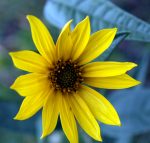
Native to the Great Plains of central North America, this herbaceous perennial is a member of the aster family, Asteraceae, that also includes daisy, yarrow, and lettuce. With a rhizomatous root system, the branching plants grow 2-10′ tall and have alternate, grayish green, hairy leaves that are lanceolate, 3-12′ long, and are often folded down the midvein. For about 6 weeks starting in mid-summer, 2-3″ wide flowerheads appear on short stems in the upper leaf axils. They are composed of 15-19 yellow ray florets surrounding a center of darker yellow disc florets. Plants may self seed. The flowerheads are attractive to butterflies, the seedheads are attractive to birds, and the flowers are good in the vase. Plants are a good choice for the back of the border and for cottage, meadow, prairie, wildflower, native plant, and butterfly gardens. The genus name, Helianthus, comes from the Greek words helios, meaning sun, and anthos meaning flower and may refer to the resemblance of the flowerhead to the sun. The specific epithet, maximiliani, and common name, honor Prince Maximilian of Wied-Neuwied, a German explorer who found the plant on his travels in North America.
Type: Herbaceous perennial
Bloom: Flowerheads 3-4″ wide with yellow ray florets surrounding darker yellow disc florets for 6 weeks beginning in mid summer
Size: 2-10′ H x 2-4′ W
Light: Full sun
Soil: Average, dry to medium moist, well-drained; drought tolerant
Hardiness: Zones 4-9
Care: Plants may need staking
Pests and Diseases: Downy mildew, Fusarium
Propagation: Seed, division
Companion Plants: Asters, goldenrod, ornamental grasses
Photo Credit:Wikipedia
 Karen Meyers