
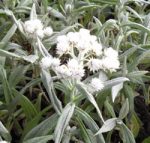
Native to the Himalayas of Tibet, Afghanistan, northern India, Nepal, and Bhutan, triple-veined pearly everlasting is a clump-forming herbaceous perennial belonging to the aster family, Asteraceae, that also includes daisy, yarrow, and lettuce. It grows 12-24″ tall and has a zigzag stem and very narrow obovate to elliptic-obvates leaves. The leaves are 5-8″ long, gray above and heavily felted beneath. They usually have 3 veins but sometimes have 5. From mid-summer to fall, plants produce 2″ wide dense clusters of flowerheads that are 3/4″ wide and have fuzzy, papery, thread-like white bracts surrounding a center of yellow disc flowers. Plants are useful as ground covers and in borders and informal gardens. The flowers are attractive in both dried and fresh arrangements. The genus name, Anaphalis, is the classical Greek name for another everlasting plant. The specific epithet, triplinervis, is from the Greek word triplex meaning three and the Latin word nervosus meaning tendon and refers to the veins in the leaves of the plant.
Type: Herbaceous perennial
Bloom: White flowerheads with yellow centers from mid summer into fall
Size: 1.5-2″ H x 1′ W
Light: Full sun but tolerates lightly dappled shade.
Soil: Average, consistently moist, well-drained; tolerates damp soils, but not dry soils.
Hardiness: Zones 3-9
Care: Low maintenance; fertilize if soil infertile; divide every 3-4 years.
Pests and Diseases: Susceptible to leaf damage by caterpillars
Propagation: Division in fall, seed
Companion Plants: Sedum ‘Matyrona’, maiden grass ‘Cosmopolitan’, Anemone ‘Queen Charlotte’
Outstanding Selections: ‘Summer Snow’ (late summer, 10″ tall)
Photo Credit: Wikimedia