
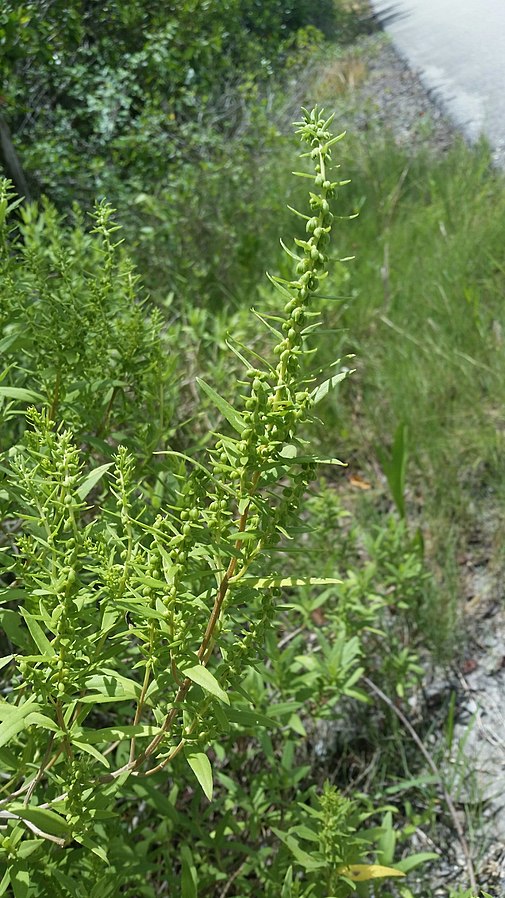
Also known as Jesuit’s bark and high-tide bush, this deciduous shrub is native to coastal areas of North America from Nova Scotia to Florida and along the Gulf Coast to Texas where it is common in salt marshes. It is a member of the aster family, Asteraceae, that also includes sunflower, yarrow, and lettuce. The plant can grow up to 12′ tall and has branched erect stems that carry oppositely arranged, fleshy, lanceolate to oval leaves. The leaves are 1.2-8″ long, dull green, and have toothed margins. In late summer terminal panicles of inconspicuous flowerheads appear. They consist of small pink to brown tubular female florets and lighter colored male disc florets. The fruit is a dark purplish brown achene covered with pale dots of resin. Marsh elder is known for its high tolerance of saline soil but is not tolerant of flooding and so tends to grow in a narrow band along the upper margins of saline marshes. It is useful for embankment restoration and stabilization, and because it takes well to pruning can be used as a low hedge in the landscape. The genus name, Iva, is of uncertain origin. The specific epithet, frutescens, is from the Latin word frutex meaning shrub.
Type: Deciduous shrub
Outstanding Feature: Tolerance of saline soil
Form: Oval
Growth Rate: Medium
Bloom: Inconspicuous panicles of flower heads with male and female disc florets in late summer
Size: 4-12′ H x 6-12′ W
Light: Full sun
Soil: Average, moist, alkaline; moderately tolerant of drought and occasional flooding
Hardiness: Zones 8-10
Care: low maintenance
Pests and Diseases: None of significance
Propagation: Seed
Photo Credit: Jay Horn Wikimedia Commons