
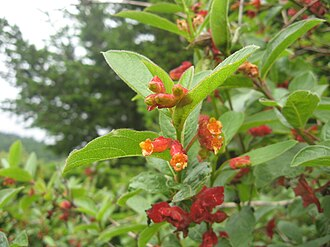
Honeysuckles (Lonicera) are arching shrubs or twining vines in the honeysuckle family, Caprifoliacea, that also includes scabiosa, weigela, and abelia. They are native to northern latitudes in North America, Eurasia, and North Africa where they are found in a variety of habitats including woodlands, pastures and disturbed areas. The plants grow up to 20′ tall an have fibrous stems that carry oval to egg-shaped leaves. The leaves are .4-4″ long, have smooth margins, and may be deciduous or evergreen . The tubular or trumpet-shaped flowers appear in clusters or pairs in early summer, and are often fragrant and two-lipped. They come in a variety of color including white, pink, red or a combination of colors. The flowers of many are attractive to pollinators including butterflies and hummingbirds and the red, blue, or black berries that follow are often attractive to birds but may be poisonous to humans. Photo Credit: Wikipedia
Honeysuckles like full sun (but some tolerate some shade), and average, moderately moist, well-drained soil in USDA Hardiness Zones 4-9 depending on the species. Plants are generally healthy but are susceptible to damage by aphids, spider mites, and powdery mildew. Propagation is by layering or stem cuttings.
The genus name Lonicera honors Adam Lonicer October 1528- May 1586), a Renaissance German botanist.
The environmental conditions of the Southwest have resulted in at least 10 native species of honeysuckle but they may be native to other areas of the US too. The honeysuckles described here are native to at least one of the states on the Southwest.
Western White Honeysuckle (Lonicera albiflora)
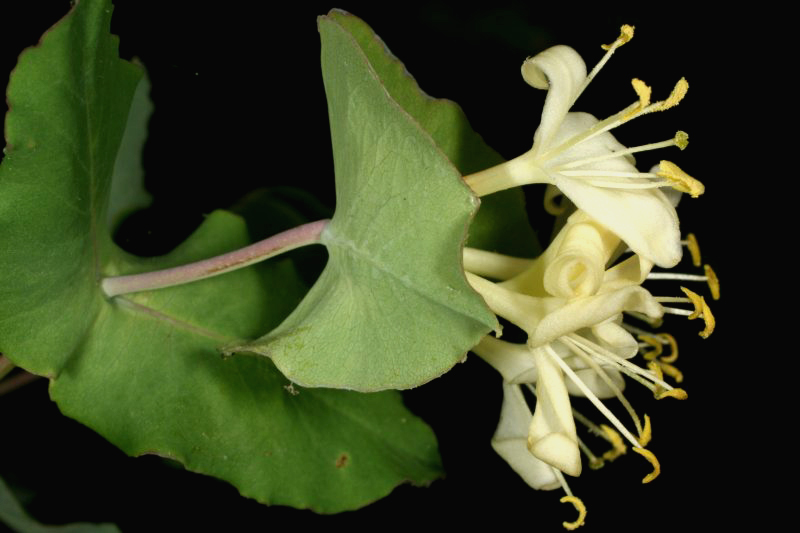
Long, slender, branches may twine, climb, and cover structures such as fences. They carry broadly oval leaves that are slightly hairy, 1.5-3″ long with the top pair fused at the base to form a disc. Two to three inch wide clusters of white to pale yellow flowers appear at the ends of branches in mid spring to early summer. The flowers are 5/8″ long, tubular, two lipped, and lack fragrance. They give way to clusters of small orange-red berries. The flowers are attractive to butterflies and other pollinators including bumble bees, and the berries are attractive to birds.
Alternate Name/s: White Shrub Honeysuckle, white bush honeysuckle, white limestone honeysuckle, Texas honeysuckle
Native Range: New Mexico, Arizona, Texas and Oklahoma
Habitat: Moist to dry places, woodland, stream banks , cliffs
Type: Deciduous, perennial trailing shrub or vine
Height: 4-10′
Bloom Time: Mid spring to early summer
Bloom Color: White to pale yellow
Light: Full sun to partial shade
Soil: Dry to moist, well-drained; limestone based
USDA Hardiness Zones: 7-10
Photo Credit: SeiNET
Arizona Honeysuckle (Lonicera arizonica)
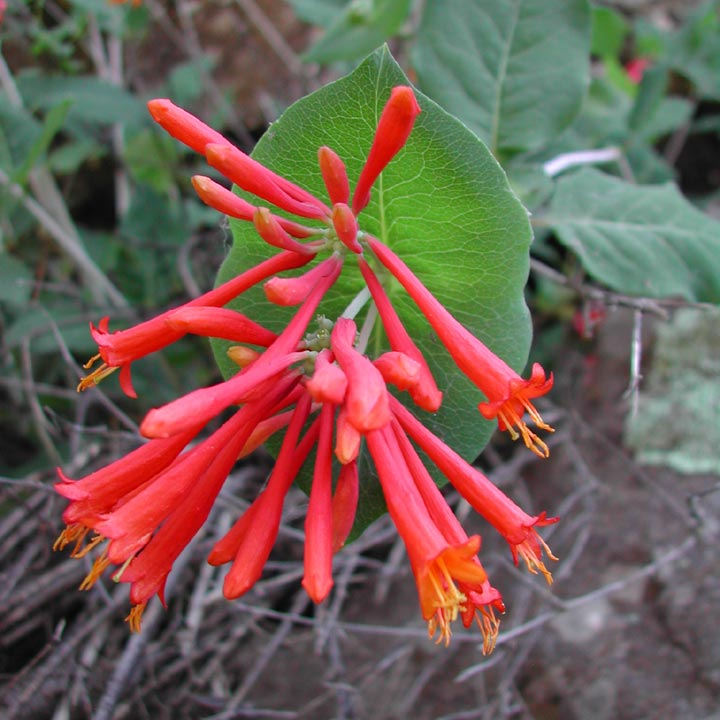
With a with a spreading or climbing habit this perennial vine or shrub has oval to elliptical leaves that are 1.5 to 3″ long, with the top most pair joined at the base to form a disc. Two to three whorled terminal clusters of flowers appear from late spring to mid summer. The tubular, two-lipped flowers are 1-2″ long, red with orange interiors, and are followed by small red berries. The flowers are attractive to hummingbirds and other pollinators including bumble bees.
Alternate Name/s: None
Native Range: New Mexico, Arizona and Texas
Habitat: Upper elevations of mountainous regions, often in open coniferous forests.
Type: Trailing or climbing perennial vine or shrub
Height: 3–6′, but can sprawl or climb up to 10 feet with support
Bloom Time: Late spring to mid summer
Bloom Color: Bright red to reddish-orange, often with yellow throats
Light: Full sun to partial shade
Soil: Average, medium moist, well-drained, slightly acidic
USDA Hardiness Zones: 5-9
Photo Credit: SEINet Portal Network
Orange Honeysuckle (Lonicera ciliosa)
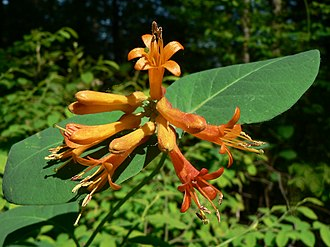
This twining climber has has opposite, oval leaves 1.5-4″ long, with the terminal pair fused to form a single disc. From late spring to mid summer whorled terminal clusters of orange flowers appear. They are tubular, two-lipped, .75-1.5″ long, and have 5 lobes. The flowers are attractive to pollinators and hummingbirds and give way to an orange-red berry less than 3/8″ across.
Alternate Name/s: Western trumpet honeysuckle
Native Range: Arizona as well as places in the Rocky Mountain area and Pacific Coast
Habitat: Open woods and thickets
Type: Deciduous perennial vine
Height: 10-20′
Bloom Time: Late spring to mid summer
Bloom Color: Orange
Light: Partial shade; tolerates full sun
Soil: Fertile, consistently moist, well-drained
USDA Hardiness Zones: 5-9
Photo Credit: Wikipedia
Limber Honeysuckle (Lonicera dioica)
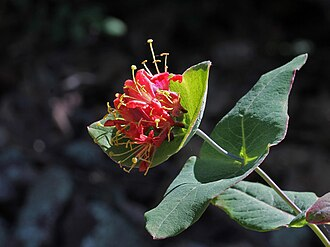
This vine-like shrub has arching and twining branches that crawl over neighboring vegetation. The leaves are 1-3″ long, elliptical lanceolate or bovate, and the uppermost pairs are fused around the stem at their base. Clusters of red, two-lipped, tubular flowers are arranged in whorls at the tips of the branches. Each flower is 1/2-1″ long, has yellow stamens, and gives rise to a small round to oval, red to orange berry. The flowers are attractive hummingbirds and the berries are eaten by birds.
Alternate Name/s: Glaucous honeysuckle, mountain honeysuckle, red honeysuckle, smooth-leaved honeysuckle, twining honeysuckle
Native Range: Oklahoma as well as places in the Rocky Mountain area, Midwest, Southeast, Mid-Atlantic, and New England
Habitat: Thickets, outcrops, boggy areas, rocky slopes, woods
Type: Deciduous perennial vine-like shrub
Height: 2-10
Bloom Time: Spring
Bloom Color: Red
Light: Full sun to partial shade
Soil: Average, medium most, well-drained; tolerates occasional dry soil and occasional wet soil
USDA Hardiness Zones: 3-5
Photo Credit: Wikipedia
Yellow Honeysuckle (Lonicera flava)
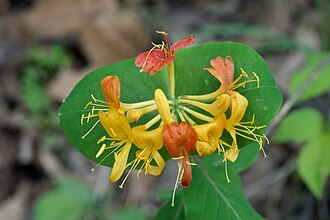
This woody vine may crawl along the ground, form a small shrub, or climb a sturdy structure. The leaves are elliptical, 3-5″ long, and the uppermost pair is fused around the stem at the base. The yellow to orange flowers appear in whorls at the end of the stems in mid to late spring. Each flower is tubular, two-lipped, 1.25″ long, and gives way to small orange-red berries. The flowers attract butterflies, hummingbirds and other pollinators and the berries attract birds.
Alternate Name/s: None
Native Range: Oklahoma as well as places in the Rocky Mountain area, Midwest, and Southeast
Habitat: Woodlands and forests, margins of streams and rivers
Type: Deciduous perennial woody vine
Height: 10-20′
Bloom Time: Mid to late spring
Bloom Color: Yellow, orange
Light: Full sun to partial shade
Soil: Average, medium, well-drained
USDA Hardiness Zones: 5-8
Photo Credit: Wikipedia
Chaparral Honeysuckle (Lonicera interrupta)
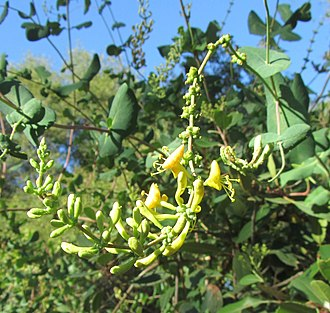
The oval to lanceolate leaves are up to 1.5″ long and may appear to encircle the stem. Spikes of irregularly spaced whorls of yellow to cream flowers appear from late spring to early summer. The flowers are 1/2″ long, two-lipped, and have stamens and stigma that extend well beyond the reflexed corolla. Small red berries follow. The flowers are attractive to butterflies, hummingbirds and other pollinators, and the fruits are attractive birds.
Alternate Name/s: None
Native Range: Arizona as well as areas on the Pacific Coast
Habitat: Chaparral and oak woodland in foothills and mountain ranges
Type: Deciduous perennial shrub
Height: 3-5′
Bloom Time: Late spring to early summer
Bloom Color: Yellow to cream turning red to orange as fruits ripen
Light: Full sun to partial shade
Soil: Average, dry to medium moist, well-drained; drought tolerant
USDA Hardiness Zones: 7-8
Photo Credit: Wikipedia
Twinberry (Lonicera involucrata)
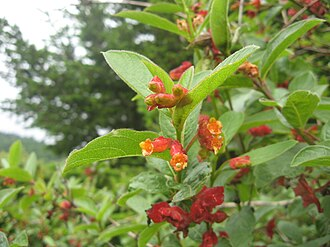
The elliptic to oval-shaped leaves are 1–5 1/2″ long, have hairy margins and undersides, and tips that that narrow sharply to a point. Pairs of tubular, two-lipped flowers appear from early to mid summer. Each flower is 1″ long, yellow and surrounded by green bracts that turn orange to red as the fruits ripen. The fruit that follows is a small black berry. The flowers attract hummingbirds, butterflies, and other pollinators while the fruits provide food for birds, small mammals and bears.
Alternate Name/s: Bearberry honeysuckle, bracted honeysuckle, twinberry honeysuckle, Californian honeysuckle, black twinberry, inkberry honeysuckle
Native Range: Arizona and New Mexico as well as places in the Rocky Mountain area, Pacific Coast, and Midwest
Habitat: Moist, wooded areas, clearings and on the edges of wetlands
Type: Deciduous perennial shrub
Height: 3-10′
Bloom Time: Early to mid summer
Bloom Color: Yellow
Light: Full sun to partial shade; shade tolerant
Soil: Average, consistently moist, well-drained soil
USDA Hardiness Zones: 4-10
Photo Credit: Wikipedia
Grape Honeysuckle (Lonicera reticulata)
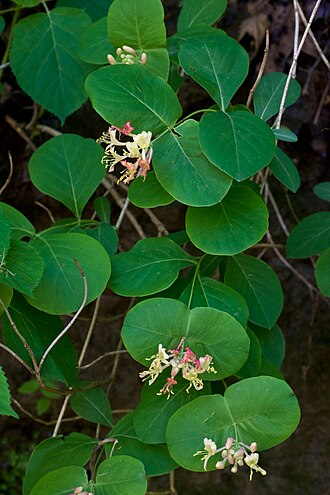
Twining stems carry oval to round leaves 1½ to 3½” long. The upper most 1-2 pair of leaves are fused into a disc like structure that is a grayish-green or blue color. One to two clusters of of flowers appear in whorls of 2-6 above the terminal leaf disc in late spring to early summer. Each flower is pale yellow aging to pink, fragrant, ¾–1″ long, tubular, slender, and two-lipped with stamens protruding beyond the corolla. The fruits that follow are red and form a cluster resembling a small bunch of grapes. The flowers attract hummingbirds and the berries attract birds and small mammals.
Alternate Name/s: None
Native Range: Oklahoma as well as places in the Midwest, Southeast, and Mid-Atlantic
Habitat: Woodlands, savannas, thickets
Type: Deciduous, perennial, woody vine
Height: 10-15′
Bloom Time: Late spring to early summer
Bloom Color: Pale yellow to orange-yellow
Light: Full sun to part sun
Soil: Average, medium moist, well-drained
USDA Hardiness Zones: 4-8
Photo Credit: Wikipedia
Trumpet Honeysuckle (Lonicera sempervirens)
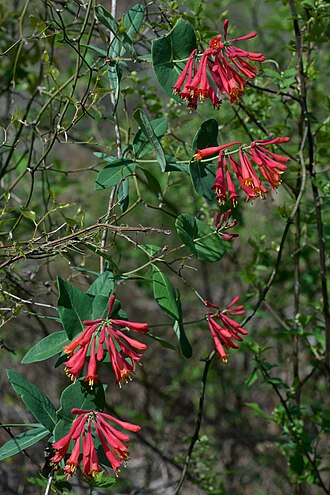
This semievergreen twining climber has bluish green leaves that are oval and 1-3″ long. The upper pair of leaves are fused into a disc. From mid spring to early summer, whorled clusters of non-fragrant flowers appear above the leaf disc. The narrow tubular flowers are 1/2 to 2″ long, two lipped, and red with a yellow throat. The fruit that follows is an inedible red berry. The flowers are attractive to hummingbirds, butterflies and other pollinators and the berries are attractive to birds. Plants are salt tolerant and so a good choice for coastal gardens.
Alternate Name/s: Coral honeysuckle, scarlet honeysuckle
Native Range: Oklahoma and Texas as well as places in the Midwest, Southeast, Mid-Atlantic, and New England
Habitat: Forest edges, woodlands
Type: Semievergreen, perennial woody vine
Height: 8-20′
Bloom Time: Mid spring to early summer
Bloom Color: Red, yellow
Light: Full sun
Soil: Organically rich, medium moisture, well-drained
USDA Hardiness Zones: 4-9
Photo Credit: Wikipedia
Utah Honeysuckle (Lonicera utahensis)
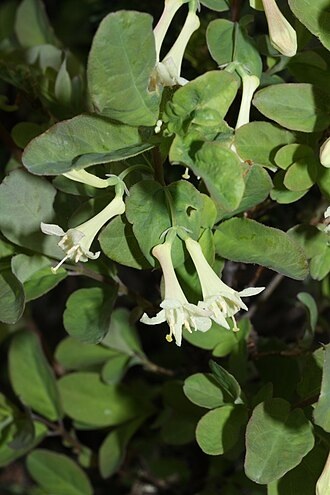
Slender, spreading branches carry thin leaves that are oval to broadly oblong and .8-3.25″ long . Tubular or bell-shaped, slightly two-lipped flowers appear in pairs on slender stalks at the leaf axils from late spring to early summer. Themflowers are 0.4–0.8 long, pale yellow to creamy white (sometimes tinged with green), and give way to small red berries that are attractive to birds and mammals.
Alternate Name/s: Red twinberry, fly honeysuckle
Native Range : Arizona and New Mexico as well as places in the Rocky Mountain area and Pacific coast
Habitat: Mid to subalpine shrub communities, wooded slopes, coniferous woods, wetlands.
Type: Deciduous perennial shrub
Height: 3.5-6.5′
Bloom Time: Late spring to early summer
Bloom Color: White to pale yellow
Light: Part shade
Soil: Average, consistently moist, well-drained
USDA Hardiness Zones: 4-8
Photo Credit: Wikipedia